Arm Training Guide
The triceps are most of your arm. Train them like it.
The best exercise for each head, a triceps workout chart, and two ready-to-run routines.
The best tricep workouts combine three things: an overhead extension, such as the overhead cable triceps extension, to stretch the long head; a pushdown to load the lateral and medial heads; and a heavy press like the close grip bench press. Do 2 to 4 hard sets of each, once or twice a week, in the 6 to 15 rep range, and add a rep or a little weight whenever you can.
That is the short answer. The rest of this guide explains why the overhead position matters, which exercise suits which head, how to do a close grip bench press properly, and how to fit all of it into the training you already do. If you have read our bicep workout guide, this is its other half.
Tricep Anatomy in One Paragraph
The triceps brachii sits on the back of the upper arm and has three heads that join into one tendon at the elbow, so all three straighten your arm. The lateral head is on the outside and gives the horseshoe shape. The medial head lies deeper, mostly under the other two, and works in nearly every elbow extension. The long head is the biggest, and it is the only one that crosses the shoulder: it starts on the shoulder blade, which means it also helps pull your arm down and back. Because of that, putting your arm overhead or behind your body stretches the long head, and keeping your arm by your side leaves it shorter. Every triceps exercise trains all three heads to some degree; arm position just changes which one is working at the longest length.
Why the Overhead Position Matters
There is a direct study on this. Researchers had 21 adults train triceps on a cable machine for 12 weeks, twice a week, 5 sets of 10 reps. Each person trained one arm with an overhead extension and the other arm with the arm down by the side, like a pushdown. MRI scans showed the long head grew about 28.5% in the overhead arm versus about 19.6% in the neutral arm. The lateral and medial heads together also grew more in the overhead arm (about 14.6% versus 10.5%), and the whole triceps grew about 1.4 times as much, even though the overhead arm always lifted less weight (Maeo et al., European Journal of Sport Science, 2023).
Keep it in proportion. It is one study of 21 people, the comparison was between two cable extensions, and both arms still grew a lot. It does not mean pushdowns are useless. It does make a strong case for including at least one overhead exercise in every tricep workout, which is exactly what the routines below do.
The Best Triceps Exercises, Head by Head
Sort triceps exercises into three groups by where your upper arm is: overhead, by your side, or in front of you while pressing. A complete program takes something from at least two of them.
Long head: overhead extensions
Overhead Cable Triceps Extension
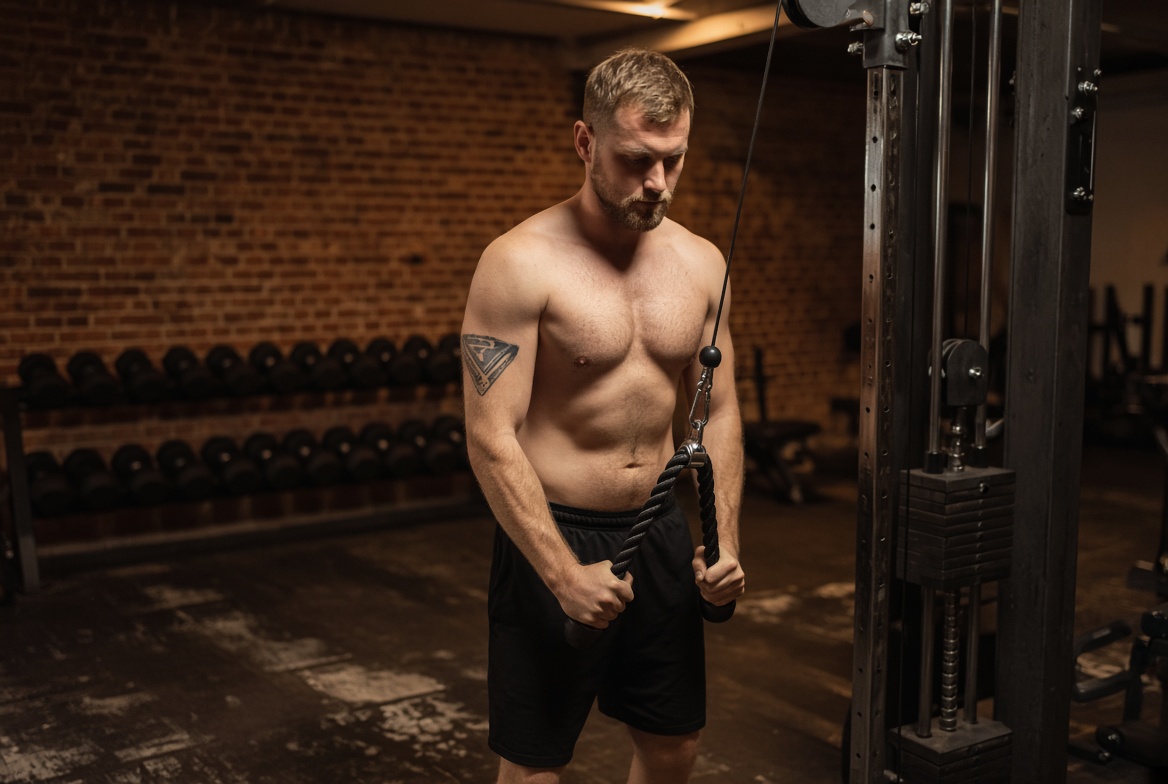
Face away from a cable with a rope, elbows pointing up beside your head, and straighten your arms forward and up. The cable keeps tension on the stretched bottom position, which is the point of the exercise.
Single Arm Overhead Cable Extension
The same movement one arm at a time. Easier on the shoulders for many people, and it lets each arm work at its own strength.
Single Arm Dumbbell Overhead Extension
The home version. Seated or standing, lower the dumbbell behind your head until your elbow is fully bent, then press it back up. A two-handed version with one heavier dumbbell also works.
Incline Barbell Triceps Extension
Lie back on a 45 to 75 degree incline and lower a barbell or EZ-bar behind your head. Loads well, and the incline puts the long head on stretch.
Lateral and medial heads: arms by your side
Triceps Pushdown
The most popular triceps exercise for good reason: easy to learn, easy to load, and kind to the elbows. Rope, straight bar or V-bar all work. Pin the elbows and straighten fully at the bottom.
Crossbody Cable Extension
One arm, pulling the cable across and out from the opposite side. Many lifters feel the outer triceps strongly here, and it tends to suit sore elbows.
Triceps Extension Machine
A fixed path and a stable seat, so you can push close to failure safely. A good choice for beginners and for the last exercise of a session.
Dumbbell Kickback
Hinge forward, upper arm parallel to the floor, and straighten the elbow. Light weights only. It is hardest at the top and easy at the bottom, so treat it as a finisher.
All three heads: presses and lying extensions
Close Grip Bench Press
The heaviest triceps exercise you can do with a barbell. It gets its own section below.
Dips
Upright torso for more triceps, forward lean for more chest. Add weight when 12 bodyweight reps are easy. The seated dip machine is a gentler way to load the same pattern.
Skull Crushers
Lying on a flat bench, lower the bar toward your forehead or just behind your head. Taking the bar slightly behind the head brings the arm back and stretches the long head more. The EZ-bar version is easier on the wrists.
Diamond Push-Ups
Hands together under your chest. The no-equipment triceps press. Elevate your feet to make it harder, or your hands to make it easier.
For a lying dumbbell option, the dumbbell tricep extension is a skull crusher done with a dumbbell in each hand and palms facing, which many people find more comfortable than a straight bar.
Close Grip Bench Press: How to Do It Right
The close grip bench press is a bench press with your hands about shoulder width apart instead of wider. Bringing the hands in and the elbows closer to your body shifts more of the work onto the triceps, while the chest and front delts still help. That combination is why it lets you move more weight than any isolation exercise, and why it is a staple for both bigger arms and a stronger regular bench press.
- Set your grip. Lie on the bench as you would for a normal bench press: eyes under the bar, shoulder blades pulled back and down, feet flat. Grip the bar with your hands about shoulder width apart. Your thumbs should not touch.
- Unrack and stack. Hold the bar over your shoulders with straight wrists, the bar over your forearm bones, not rolled back toward your fingers.
- Lower with your elbows tucked. Bring the bar down under control, about 2 seconds, with your elbows angled in toward your sides. A rough guide is about 30 to 45 degrees from your torso, closer than a regular bench. Your forearms should stay close to vertical when viewed from the side.
- Touch low. The bar touches a little lower on the chest than your normal bench press, around the bottom of the sternum. Touch lightly; do not bounce.
- Press up and slightly back. Drive the bar up and a little back toward your face so it finishes over your shoulders, and lock your elbows out fully. The lockout is where the triceps work hardest.
What the close grip bench press trains
Mainly the triceps, all three heads, with the chest and front deltoids as strong helpers. Because the long head stays fairly short with the arm in front of the body, it does not replace an overhead extension. Think of it as the heavy, strength-building anchor of a tricep workout, with the isolation work after it.
Common close grip bench mistakes
- Grip too narrow. Hands touching in the middle of the bar bends the wrists and loads the elbows awkwardly without adding triceps work. Shoulder width is enough.
- Elbows flaring out. If your elbows drift wide, the lift turns back into a regular bench press and the shoulders take more stress.
- Bouncing off the chest. The rebound takes work off the triceps at the hardest point. Touch and press.
- Wrists bent back. Keep the bar low in the palm over the forearm. Wrist wraps can help on heavier sets.
- Half reps. Lock out every rep. Stopping short skips the part of the lift the triceps own.
Close grip bench press: sets and reps
- For strength and size: 3 to 4 sets of 6 to 10 reps, 2 to 3 minutes rest
- Place it first on a triceps-focused day, or after your main bench press on push day
- Starting weight: as a rule of thumb, most people close grip noticeably less than their regular bench, so start light and build up
Use a spotter or safety arms, as with any bench press. If you want to estimate a working weight from a recent set, the one rep max calculator converts any set of reps into an estimated max you can plan from.
Triceps Workout Chart
Screenshot this and take it to the gym. Pick 3 or 4 exercises per session, including at least one overhead movement (marked long head) and one from another row.
Triceps Workout Chart
gymgod.app
| Exercise | Head emphasized | Equipment | Sets x reps | Rest |
|---|---|---|---|---|
| Close grip bench press | All three | Barbell | 3-4 x 6-10 | 2-3 min |
| Dips | All three | Dip bars | 3 x 6-12 | 2 min |
| Overhead cable extension | Long | Cable + rope | 3 x 10-15 | 60-90 sec |
| Dumbbell overhead extension | Long | Dumbbell | 3 x 10-15 | 60-90 sec |
| Skull crusher (EZ-bar) | Long + all | EZ-bar | 3 x 8-12 | 90 sec |
| Triceps pushdown | Lateral + medial | Cable | 3 x 10-15 | 60-90 sec |
| Crossbody cable extension | Lateral + medial | Cable | 2-3 x 12-15 | 60 sec |
| Triceps extension machine | Lateral + medial | Machine | 2-3 x 10-15 | 60-90 sec |
| Diamond push-up | All three | Bodyweight | 3 x to 2 short of failure | 60-90 sec |
| Dumbbell kickback | Lateral + medial | Dumbbell | 2 x 12-20 | 60 sec |
Aim for 6 to 14 direct triceps sets per week. Stop most sets 1 to 3 reps short of failure. Add a rep or a little weight when you hit the top of the range on every set.
"Head emphasized" is a guide, not a guarantee. Every one of these exercises works all three heads; the label tells you which head is likely loaded at the longest length or works hardest, based on arm position.
A Gym Tricep Workout
This is a stand-alone triceps block for a gym with a barbell and cables. Do it once a week as the arm part of a longer session, or split it in half across two push days. It takes about 30 minutes.
| Exercise | Sets x reps | Rest |
|---|---|---|
| Close grip bench press | 3 x 6-10 | 2-3 min |
| Overhead cable triceps extension | 3 x 10-15 | 60-90 sec |
| Triceps pushdown (rope) | 3 x 10-15 | 60-90 sec |
| Optional: crossbody cable extension | 2 x 12-15 per arm | 60 sec |
That is 9 to 11 direct sets. If your shoulders or elbows complain on the overhead cable extension, use the single-arm version, or switch to an incline barbell extension. Swap the close grip bench for weighted dips if you prefer them and your shoulders tolerate them.
A Dumbbell-Only Tricep Workout at Home
With a pair of dumbbells and a bench (or the floor), you can cover every position the gym version does.
| Exercise | Sets x reps | Rest |
|---|---|---|
| Diamond push-ups (feet raised if easy) | 3 x 2 reps short of failure | 90 sec |
| Dumbbell overhead extension (one or two hands) | 3 x 10-15 | 60-90 sec |
| Lying dumbbell triceps extension | 3 x 10-12 | 60-90 sec |
| Dumbbell kickback | 2 x 12-20 per arm | 60 sec |
Without a bench, do the lying extension on the floor as a floor skull crusher; the floor stops your elbows at a safe depth. Dumbbells jump in 5-pound steps, which is a big percentage on a triceps extension, so lean on adding reps and slowing the lowering phase before you go up a weight. Pairing the overhead extension with a curl from the bicep routine as a superset trains both sides of the arm in about the same time as one.
How Many Sets Do Your Triceps Need?
Your triceps work on every bench press, overhead press, dip and push-up. That pressing counts toward their total workload, even if it does not count fully as a direct triceps set. A meta-regression of weekly training volume found that more weekly sets per muscle went with more growth, with the clearest benefit up to about 10 or more sets per week (Schoenfeld, Ogborn and Krieger, Journal of Sports Sciences, 2017). For someone already pressing a few times a week, a rule of thumb is 6 to 14 direct triceps sets per week on top of that.
More is not automatically better. If your elbows ache or your presses start going backward, you are probably doing too much, and cutting triceps isolation sets is often the easiest fix. Reps from about 6 to 15, taken close to failure, all build muscle; use heavier sets on presses and lighter, higher-rep sets on extensions, which are harder on the elbow joint.
How to Fit Triceps Into Your Split
You rarely need a separate triceps day. The best spot depends on which of the common workout splits you run.
- Push/pull/legs: triceps finish each push day. Our push day workout already ends with a pushdown and an overhead cable extension, which matches this guide. If you run PPL twice a week, use the gym block above split across both push days: close grip bench and pushdowns on one, overhead extensions and skull crushers on the other.
- Upper/lower: put 2 to 3 sets of one triceps exercise at the end of each upper day, alternating overhead and pushdown work. The upper lower split guide shows where arms fit.
- Full body: add one triceps exercise for 2 sets to two of your three weekly sessions.
- Body part split: on an arm day, do this whole tricep workout and pair it with curls. If you also have a chest day, count the pressing on that day too, and keep a day between them so your triceps are fresh.
Order matters. Do triceps isolation after your chest and shoulder presses, not before. Pre-tiring the triceps weakens your bench and overhead press, which are the lifts that move the most weight.
How to Progress Your Tricep Workouts
Use double progression. Pick a rep range, such as 10 to 15 on overhead extensions. Start with a weight you can do 10 times on every set, add reps each session until all sets reach 15, then increase the weight and start again at 10. On the close grip bench, small plates (1.25 kg or 2.5 lb per side) make the weight jumps manageable.
When reps stall for two or three sessions, try a slower 3-second lowering phase or a pause at the stretched position before you add sets. Our guide to progressive overload covers each option. After several hard weeks, a deload week lets cranky elbows settle before the next push. All of this depends on knowing last week's numbers, so write them down; the printable weight training log works if you prefer paper.
Common Tricep Workout Mistakes
- Skipping overhead work. Pushdowns alone leave the long head, the biggest head, without its strongest growth stimulus.
- Elbows drifting. On pushdowns, elbows moving forward turn the exercise into a lat and chest press. On overhead extensions, elbows flaring wide shortens the stretch. Keep them roughly in place.
- Leaning over the pushdown. Bending way over the bar lets bodyweight do the work. Stand tall with a slight forward lean at most.
- Partial reps. Lower until your elbow is fully bent and finish with your arm fully straight. The stretched bottom is where overhead work earns its keep.
- Ignoring the pressing you already do. Ten sets of bench and overhead press plus fifteen sets of triceps isolation is a lot of elbow work. Count it all.
The Honest Downsides
Elbow pain is common. Heavy skull crushers and deep dips are the usual culprits, because both put a lot of stress on the elbow and, for dips, the front of the shoulder. If either hurts, go lighter, switch to an EZ-bar or dumbbells, shorten the dip depth, or use cables, which feel smoother for most people. Pain that sticks around between sessions is a reason to see a professional, not to push through.
Your triceps are already busy. If you bench, overhead press and do push-ups, your triceps get plenty of work before you add a single extension. Piling isolation on top can tip you past what you recover from. Total volume matters more than finding the perfect exercise.
Arms grow slowly. The triceps are a fairly small muscle, so even good progress is a matter of millimeters per month. Measure over months, not weeks, and judge your program by whether your extension and close grip numbers keep rising.
Know What to Beat Before Your First Set
Double progression on triceps only works if you remember exactly what you did last time, down to the rep. GymGod shows your last weights, reps and goals the moment you start an exercise, and its auto-progression calculates your next target from what you actually lifted, so your overhead extension comes with a number to beat. Not sure triceps are what is holding your progress back? The What's Blocking Your Gains quiz takes a couple of minutes.
Frequently Asked Questions
What is the best tricep workout?
A heavy press such as the close grip bench press or dips, an overhead extension for the long head, and a pushdown. Do 2 to 4 sets of each, once or twice a week, and add reps or weight over time.
Which triceps exercise works the long head?
Overhead extensions, with a cable, dumbbell or barbell. The long head crosses the shoulder, so raising the arm overhead stretches it. A 12-week study found more triceps growth from overhead cable extensions than from extensions with the arm at the side.
How wide should my grip be on the close grip bench press?
About shoulder width. Going narrower than that, with hands touching, mostly strains the wrists and elbows without adding triceps work.
How often should I train triceps?
Once or twice a week, with about 6 to 14 direct sets in total as a starting point. Your triceps also work during every bench press, overhead press and dip.
Can I build triceps with only dumbbells?
Yes. Dumbbell overhead extensions, lying dumbbell extensions, diamond push-ups and kickbacks cover every arm position. Progress by adding reps before moving up a dumbbell.
Why do skull crushers hurt my elbows?
They load the elbow heavily at the bottom of the rep. Use an EZ-bar or dumbbells, lighter weight and higher reps, or switch to cable extensions, which most people find easier on the joint.