
Workout Guide
One push day, three levels, and a way to make it harder every week.
Sets, reps, rest, warm-up and progression for chest, shoulders and triceps.
What Is a Push Day Workout?
A push day workout trains every muscle that pushes weight away from your body: chest, shoulders and triceps. A solid one is 5 to 7 exercises: a heavy press (bench press), an incline press, an overhead press (dumbbell shoulder press), a chest fly, a lateral raise and one or two triceps movements, done for 2 to 4 sets each in about 60 minutes.
Below is the full routine, with a beginner and an advanced version, a warm-up, a week-by-week progression plan, and an honest look at where the push/pull/legs split falls short.
The Complete Push Day Workout (Intermediate)
This is the main version. Do the exercises in this order: big compound lifts first while you are fresh, isolation work last. Use a weight that leaves 1 to 3 reps in reserve on most sets, and go closer to failure on the last set of the isolation moves.
| Exercise | Sets | Reps | Rest |
|---|---|---|---|
| Barbell Bench Press | 3-4 | 5-8 | 2-3 min |
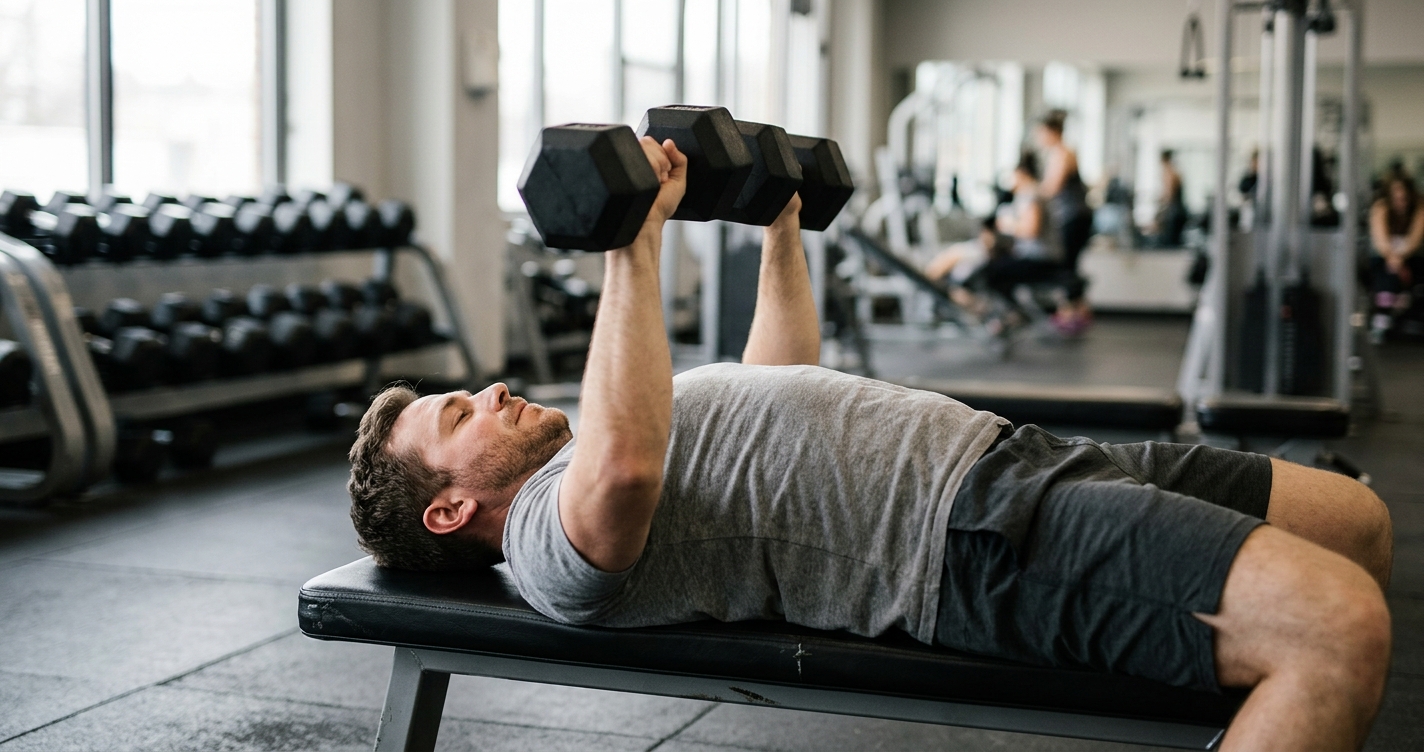
| Incline Dumbbell Bench Press | 3 | 8-12 | 2 min |
| Dumbbell Shoulder Press | 3 | 8-12 | 2 min |
| Cable Fly | 3 | 12-15 | 60-90 sec |
| Lateral Raise | 3 | 12-20 | 60 sec |
| Triceps Pushdown | 3 | 10-15 | 60-90 sec |
| Overhead Cable Triceps Extension | 2-3 | 10-15 | 60-90 sec |
Why this order and these rep ranges? Heavier sets of 5 to 8 on the bench build strength and let you load the movement progressively. The 8 to 15 rep work supplies most of the muscle-building volume and is easier on your joints. Muscle growth happens across a wide range of rep counts as long as sets are taken close to failure, so hard sets and steady progress matter more than the exact numbers. For more on that, read our guide on building muscle vs. getting stronger.
Beginner Push Day Workout
If you have trained for less than about six months, you need fewer exercises and more practice with each. Three to four movements, done once or twice a week, will beat a long routine you cannot recover from.
| Exercise | Sets | Reps | Rest |
|---|---|---|---|
| Dumbbell Bench Press | 3 | 8-12 | 90-120 sec |
| Dumbbell Shoulder Press | 3 | 8-12 | 90-120 sec |
| Lateral Raise | 2 | 12-15 | 60 sec |
| Triceps Pushdown | 2-3 | 10-15 | 60 sec |
Cannot press a dumbbell for 8 reps yet? Start with push-ups or the incline chest press machine, then move to dumbbells as you get stronger. Dumbbells are friendlier than a barbell for beginners because each arm moves on its own path.
Advanced Push Day Workout
Experienced lifters usually need more volume and more variety to keep progressing. This version adds a second chest angle, a heavy triceps compound and a back-of-shoulder movement to keep the joint healthy.
| Exercise | Sets | Reps | Rest |
|---|---|---|---|
| Barbell Bench Press | 4 | 4-6 | 3 min |
| Incline Bench Press | 3 | 6-10 | 2-3 min |
| Overhead Press | 3 | 6-10 | 2-3 min |
| Triceps Dips (add weight when 12 is easy) | 3 | 8-12 | 2 min |
| Low-to-High Cable Fly | 3 | 12-15 | 60-90 sec |
| Lateral Raise | 4 | 12-20 | 60 sec |
| Skull Crushers | 3 | 8-12 | 90 sec |
| Face Pull (shoulder health) | 3 | 15-20 | 60 sec |
The face pull is technically a pulling move. It earns a place here because heavy pressing tends to round the shoulders forward, and a little rear-delt work balances that out.
Chest and Tricep Workout: If That Is All You Want
Plenty of people search for a chest and tricep workout because they want a short session built around those two muscles. The push day above already covers it, because your triceps work on every pressing set. For a chest-and-triceps-only session, drop the shoulder press and lateral raises and use this:
| Exercise | Sets | Reps | Rest |
|---|---|---|---|
| Barbell Bench Press | 4 | 5-8 | 2-3 min |
| Incline Dumbbell Bench Press | 3 | 8-12 | 2 min |
| Close-Grip Bench Press | 3 | 6-10 | 2 min |
| Cable Fly | 3 | 12-15 | 60-90 sec |
| Triceps Pushdown | 3 | 10-15 | 60-90 sec |
| Skull Crushers | 3 | 8-12 | 90 sec |
Your shoulders still assist on every chest press, so skipping direct shoulder work for long can leave them as the weak link. Use this session occasionally rather than as your only upper-body push work.
How to Warm Up for a Push Day
Spend 5 to 8 minutes on this before your first working set:
- 2 to 3 minutes of light cardio or arm circles to raise your temperature.
- 1 set of 10 to 15 band pull-aparts to wake up the muscles around your shoulder blades.
- Ramp-up sets on your first lift: for example, the empty bar for 10 reps, then roughly 50%, 70% and 85% of your working weight for 5, 3 and 1 to 2 reps. Stop well short of fatigue.
How to Progress Week to Week
A routine only works if it gets harder over time. This is progressive overload, and a simple double progression makes it concrete:
- Pick a rep range, such as 8 to 12 on the incline press.
- Use a weight where you can reach the bottom of the range with good form.
- Add a rep each week until every set hits the top of the range.
- Then add the smallest weight jump available (often 2.5 to 5 lb, or 1 to 2 kg) and start over at the bottom.
If you are unsure what your top-end strength is, the one-rep max calculator can estimate it from a set of 5 to 10, and the RPE calculator helps you pick loads by effort. If progress stalls for two weeks in a row, or every 6 to 8 weeks, take an easier week with about half the sets.
How Often Should You Do a Push Day?
Most people do well with push day once or twice a week. Research generally supports training each muscle at least twice weekly when total volume is equal, but total weekly hard sets matter more than the exact split. A common target is roughly 10 to 20 hard sets per muscle group per week. The intermediate workout above gives about 9 to 10 chest sets and 6 to 7 triceps sets, so twice a week is plenty for most people, and once a week is fine for beginners or anyone short on time.
Push/Pull/Legs: Benefits and Downsides
What it does well
- It groups muscles that work together, so each session is focused and easy to plan.
- It scales: run it three days a week, or six if you want more volume.
- Each muscle gets a couple of days of rest before you train it again.
Where it falls short
- Run once through (3 days), each muscle is trained only once a week, which is less than ideal for many lifters. Twice-weekly frequency needs a 6-day plan, and six days is not realistic for everyone.
- Shoulders get hit on push days (and help on pull days), so they can be overused. If yours ache, trim pressing volume or swap a barbell press for dumbbells.
- Push-heavy lifters tend to neglect the back. Match your pressing volume with at least as much rowing and pulling.
- Missing one session throws off the rotation. A full-body or upper/lower split is more forgiving if your schedule is unpredictable.
No split is magic. The best one is the one you will actually follow week after week, with hard sets and progressive overload.
Common Push Day Mistakes
- Doing too many chest exercises and skipping shoulders and triceps, or the reverse.
- Flaring your elbows straight out to the sides on the bench. Tuck them to roughly 45 to 75 degrees and keep your shoulder blades pulled back.
- Swinging the weights on lateral raises. Lower the weight and slow down.
- Never writing down your numbers, so you cannot tell whether you are progressing.
Tracking Your Push Day
Progression only works if you know what you lifted last time. With auto-progression in GymGod, your next target is calculated from what you actually lifted, so you walk in with the weight already decided. You can log sets from your iPhone or Apple Watch between sets, and every exercise above is in the exercise library.
Stalling on your lifts? Take the quiz on what is blocking your gains.
Push Day Workout FAQ
What is a push day workout?
A push day workout trains the muscles that push: chest, shoulders and triceps. A typical session includes a bench press, an incline press, an overhead press, a chest fly, lateral raises and a couple of triceps exercises.
How many exercises should be in a push day?
Five to seven is enough for most people. Beginners can do three or four. More than eight usually means the later sets are low quality.
Can I do a chest and tricep workout on the same day?
Yes. Your triceps assist every pressing movement, so training chest and triceps together is efficient. Put the chest compounds first and the triceps isolation work after.
How many sets per muscle should I do each week?
Many lifters grow well on roughly 10 to 20 hard sets per muscle group per week, spread over one or two sessions. Beginners can make progress with fewer.
Should I do push day twice a week?
If you can recover, yes. Training chest, shoulders and triceps twice a week is a good way to reach enough weekly volume without making one session too long.
What should I train after push day?
In a push/pull/legs split, pull day (back, biceps, rear delts) usually comes next, followed by legs. Take a rest day whenever you need it.