Dumbbell Glute Guide
Two dumbbells. Three glute muscles. One routine that works at home or in the gym.
8 exercises, a gluteus minimus deep dive, and a plan for when your dumbbells start to feel light.
A complete glutes workout with dumbbells needs two kinds of exercise: hip extension moves like the dumbbell hip thrust, Romanian deadlift and Bulgarian split squat for the big gluteus maximus, and single-leg or side-lying moves like the lateral step-up, side-lying hip abduction and hip hitch for the gluteus medius and minimus. Do 3 or 4 of these exercises per session, 2 to 4 sets each, taking most sets close to failure, two or three times a week. Because dumbbells top out at some point, you progress by adding reps, slowing the tempo, pausing and switching to single-leg versions instead of only adding weight.
That covers the short answer. The rest of this guide covers each of the 8 exercises step by step, explains what the gluteus minimus actually does (and how little we really know about training it), and gives you a two-day routine with home and gym options.
If you have access to barbells, machines and cables and you want a gym-based plan focused on glute shape, read our 10 best exercises for a heart-shaped butt. This article sticks to dumbbells, so everything here works with a pair of adjustable dumbbells and a couch or bench.
Can You Really Build Your Glutes With Dumbbells?
Yes, especially for your first year or two of training. Your glutes respond to hard sets through a full range of motion, and the load matters less than many people think. A 2017 meta-analysis by Schoenfeld and colleagues of 21 studies found that light loads (60% of your one-rep max or less) and heavy loads produced similar muscle growth when sets were taken to failure. Heavy loads still built more maximal strength, so a dumbbell plan is better for building muscle than for testing your one-rep max.
Dumbbells also make single-leg training easy, and single-leg training is where the side glutes earn their keep. When you stand on one leg, your gluteus medius and minimus have to hold your pelvis level. That makes split squats, step-ups and single-leg RDLs double-duty exercises.
Here is the honest trade-off:
What dumbbells do well
- Work at home, in a hotel or in a crowded gym.
- Make single-leg training simple, which loads each glute on its own and trains the side glutes as stabilizers.
- Let you fix side-to-side differences, because each leg has to do its own work.
- Are easy to set up and easy to change between exercises.
Where they fall short
- Your glutes outgrow them on hip thrusts and Romanian deadlifts. Many lifters can hip thrust far more than their heaviest dumbbell.
- Grip gives out before your glutes on heavy RDLs and split squats.
- A heavy dumbbell on your hips is awkward to balance and uncomfortable without a pad.
- Side glute work is harder to load than on a cable or abduction machine.
None of those limits are deal breakers. The section on progression below shows how to keep making the work harder once the weight runs out.
The Three Glute Muscles and What Each One Needs
Your glutes are three muscles stacked on the back and side of your pelvis. The quick version:
Gluteus Maximus
The big one. It extends your hip (standing up from a squat, locking out a hinge) and makes up most of the size and shape of your butt. Trained by hip thrusts, hinges, split squats and step-ups.
Gluteus Medius
Sits on the side of your hip, partly above the maximus. It lifts your leg out to the side and keeps your pelvis level when you stand on one leg. Trained by abduction and single-leg work.
Gluteus Minimus
The smallest and deepest, tucked under the medius. It works alongside the medius as a hip stabilizer and abductor. It has its own section below.
One study is worth knowing here. In a 9-week trial by Plotkin and colleagues (2023), untrained participants who did hip thrusts or back squats grew their glutes by similar amounts, measured on MRI. But the gluteus medius and minimus showed little to no growth in either group. Big hip extension lifts are great for the maximus, but they are not enough on their own if you want to train the side glutes too. That is why this workout includes dedicated medius and minimus exercises.
8 Exercises for Glutes With Dumbbells
These are the 8 exercises for glutes with dumbbells that cover all three muscles. The first four are mainly for the gluteus maximus. The last four shift toward the medius and minimus. Use the table to see the main focus of each exercise at a glance, then read the how-to for each one below.
| Exercise | Main emphasis | Also works | Sets × Reps |
|---|---|---|---|
| 1. Dumbbell Hip Thrust | Maximus | Hamstrings | 3-4 × 10-20 |
| 2. Dumbbell Romanian Deadlift | Maximus | Hamstrings, lower back | 3 × 8-15 |
| 3. Dumbbell Bulgarian Split Squat | Maximus | Quads, adductors, medius | 3 × 8-12 per leg |
| 4. Single-Leg Dumbbell Hip Thrust | Maximus | Medius, minimus, hamstrings | 2-3 × 8-15 per leg |
| 5. Dumbbell Single-Leg RDL | Maximus Medius | Hamstrings, balance | 3 × 8-12 per leg |
| 6. Dumbbell Lateral Step-Up | Medius | Maximus, quads | 3 × 8-12 per leg |
| 7. Dumbbell Side-Lying Hip Abduction | Medius Minimus | Upper maximus | 2-3 × 12-20 per side |
| 8. Dumbbell Hip Hitch | Minimus Medius | Obliques | 2-3 × 10-15 per side |
The "main emphasis" column is a practical guide, not a lab measurement. Every exercise on this list trains more than one muscle, and your own leverages will change where you feel each one.
1. Dumbbell Hip Thrust
The hip thrust loads your glutes hardest at the top, when they are fully squeezed. In a 2015 EMG study of 13 trained women, the barbell hip thrust produced more gluteus maximus activity than the back squat at similar relative loads. Higher EMG does not automatically mean more growth (the Plotkin trial above found similar glute growth from both), but it does explain why lifters feel this one so clearly in their glutes. See the full hip thrust guide.
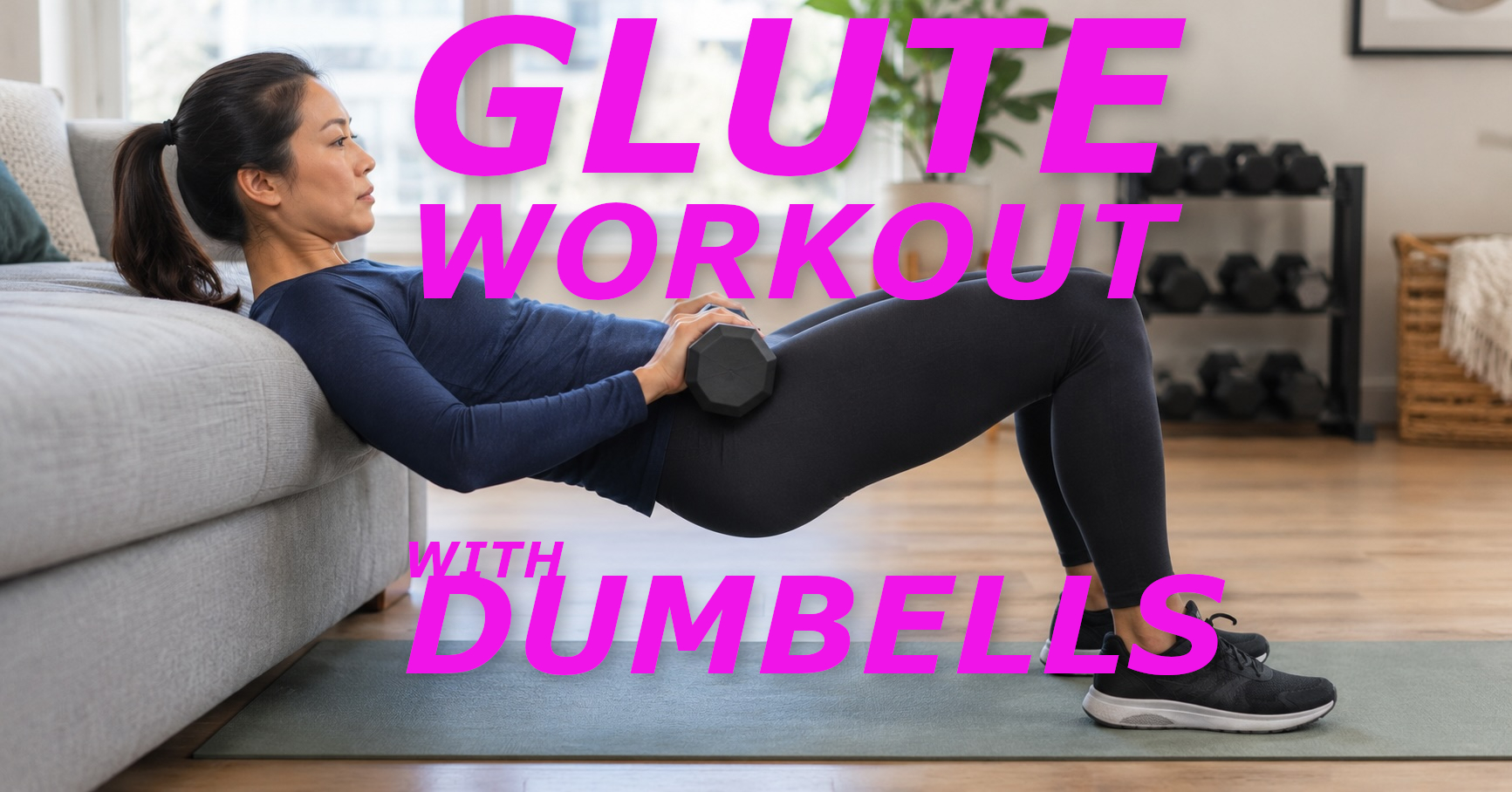
- Sit on the floor with your upper back against the edge of a bench or couch. Place one dumbbell across your hip crease, held at both ends. A folded towel underneath makes it far more comfortable.
- Plant your feet about hip width apart so your shins are roughly vertical at the top. Tuck your chin slightly and keep your ribs down.
- Brace, then drive through your heels and squeeze your glutes to lift your hips until your torso and thighs form a straight line.
- Pause for one to two seconds at the top, then lower under control until your hips nearly touch the floor.
Recommended: 3-4 sets of 10-20 reps
Pro Tip: Finish each rep by tucking your pelvis slightly instead of arching your lower back. If one dumbbell is too light, take every set close to failure, add the pause, or move to the single-leg version (exercise 4).
2. Dumbbell Romanian Deadlift
The RDL loads your glutes when they are stretched, which makes it the perfect partner for the hip thrust. Dumbbells can travel slightly to the sides of your legs, which many people find more comfortable than a barbell. See the full Romanian deadlift guide.
- Stand tall with a dumbbell in each hand in front of your thighs, feet about hip width apart, knees softly bent.
- Brace your core and pull your shoulder blades gently down and back.
- Push your hips straight back as if closing a car door with your butt. Let the dumbbells slide down close to your thighs and shins.
- Stop when you feel a strong hamstring stretch, usually around mid-shin, while your back stays flat.
- Drive your hips forward and squeeze your glutes to stand.
Recommended: 3 sets of 8-15 reps
Pro Tip: If your grip fails before your glutes and hamstrings do, use lifting straps. A three-second lowering phase makes moderate dumbbells feel much heavier.
3. Dumbbell Bulgarian Split Squat
With your back foot up on a bench, the front leg does nearly all the work, so moderate dumbbells feel heavy fast. A deep bottom position stretches the glute under load, and keeping your balance makes your side glutes work too. See the full Bulgarian split squat guide.
- Stand about two feet in front of a bench, holding a dumbbell in each hand. Rest the top of your back foot on the bench.
- Lean your torso forward slightly. A small forward lean and a longer stance shift the work toward your glutes. A tall torso and shorter stance shift it toward your quads.
- Lower straight down until your front thigh is about parallel to the floor or a little below, keeping your front heel planted.
- Push through your whole front foot to stand back up. Finish all reps on one leg before switching.
Recommended: 3 sets of 8-12 reps per leg
Pro Tip: Start each set with your weaker leg and match its reps with the stronger leg. If balance is the limit, hold one dumbbell in the hand opposite your front leg and lightly touch a wall with the other hand.
4. Single-Leg Dumbbell Hip Thrust
This is the fix for "my dumbbell is too light for hip thrusts." Working one leg puts the whole load on one glute, and your side glutes have to stop your pelvis from tipping. The single-leg bridge was one of the exercises that produced high activity in the middle gluteus medius and the back part of the gluteus minimus in a 2020 systematic review (more on that review below). See the full single leg hip thrust guide.
- Set up like a regular hip thrust, with your upper back on the bench. Rest the dumbbell on the hip of your working leg and hold it in place with your hand.
- Plant your working foot so the shin is vertical at the top. Lift the other foot off the floor and hold that knee bent.
- Drive through your working heel and lift your hips until your torso is level. Keep both hip bones at the same height.
- Pause, lower under control, and finish all reps before switching sides.
Recommended: 2-3 sets of 8-15 reps per leg
Pro Tip: Start with bodyweight. If your hips twist or the free side drops, you have found your limit for now. Add the dumbbell once you can do 15 clean reps.
5. Dumbbell Single-Leg Romanian Deadlift
The single-leg RDL stretches the glute just like the two-leg version, but standing on one leg makes the gluteus medius work hard to keep your hips square. It is humbling at first and gets easier quickly. See the full single-leg Romanian deadlift guide.
- Stand on your working leg with a soft knee. Hold a dumbbell in the opposite hand (or one in each hand).
- Hinge forward at the hip while your free leg reaches straight back, so your body moves like a seesaw.
- Keep your hips square to the floor. Do not let the free hip rotate up toward the ceiling.
- Lower until you feel a strong stretch in the working hamstring and glute, then drive your hip forward to stand tall.
Recommended: 3 sets of 8-12 reps per leg
Pro Tip: Hold a wall, rack or chair back with your free hand. Removing the balance challenge lets you load the glute much harder, and the side glutes still work to keep you level.
6. Dumbbell Lateral Step-Up
Stepping up sideways instead of forward puts more of the demand on the side of your hip. The lateral step-up was one of the best options for the middle gluteus medius in the 2020 review. See the dumbbell step-up guide for the forward version, which is a good substitute.
- Stand sideways next to a box or step about knee height or lower, holding a dumbbell in each hand.
- Place the foot closest to the box flat on top.
- Push through that foot to stand up on the box, keeping your knee in line with your toes and your pelvis level. Let the trailing leg come up without pushing off the floor.
- Lower slowly on the same leg until the trailing heel lightly touches the floor. Finish all reps before switching.
Recommended: 3 sets of 8-12 reps per leg
Pro Tip: Most of the benefit is in the slow lowering. If you bounce off the floor with the trailing foot, the box is too high or the weight is too heavy.
7. Dumbbell Side-Lying Hip Abduction
A simple way to load the side glutes with only a dumbbell. It is the home version of the hip abduction machine. The 2020 review found that side-lying abduction produced high activity in the back part of the gluteus minimus, and that doing it with the hip slightly turned in produced high activity in the middle gluteus medius.
- Lie on your side with your hips stacked and the bottom knee bent for balance. Straighten your top leg in line with your body.
- Rest a light dumbbell on the outside of your top thigh, just above the knee, and hold it in place with your top hand.
- Turn your top toes very slightly toward the floor and move the leg a touch behind your body line.
- Lift the leg toward the ceiling without rolling your hips back, pause, then lower slowly.
Recommended: 2-3 sets of 12-20 reps per side
Pro Tip: The range of motion is small, and that is fine. If you can lift your leg very high, your pelvis is probably rolling back and your hip flexors are taking over. Lie with your back against a wall to keep yourself honest.
8. Dumbbell Hip Hitch (Pelvic Drop)
It looks like almost nothing, but the hip hitch was the standout in the 2020 review: variations of it produced high activity in every segment of both the gluteus medius and the gluteus minimus. It trains exactly what these muscles do in real life, which is holding your pelvis level on one leg.
- Stand sideways on a step with one leg on the step and the other hanging off the edge. Hold a dumbbell in the hand on the hanging-leg side. Lightly hold a wall or railing with the other hand.
- Keep your standing knee straight but not locked.
- Let the hip of the hanging leg drop slowly toward the floor, as far as you can control.
- Use the side of your standing hip to lift the hanging hip back up above level. Pause at the top, then repeat. Finish all reps before switching.
Recommended: 2-3 sets of 10-15 reps per side
Pro Tip: Do not lean your torso sideways to fake the movement. The motion comes from your pelvis, and you should feel it on the outside of the standing hip, not in your waist.
Gluteus Minimus Exercises: What the Smallest Glute Does and How to Train It
The gluteus minimus is the smallest and deepest of your three glute muscles. It sits under the gluteus medius, runs from the outer surface of your pelvis to the front of the greater trochanter (the bony point on the side of your hip), and works mainly as a hip stabilizer and abductor, according to the StatPearls anatomy review by Greco and Vilella. In plain terms: it helps lift your leg out to the side and, more importantly, keeps your hip steady and your pelvis level every time you stand on one leg, which you do with every step you take.
That last point is the key to training it. The gluteus minimus shares its job, nerve and blood supply with the gluteus medius, so you cannot train one without the other. "Minimus exercises" are really side-glute exercises that happen to work the minimus especially hard.
The honest caveat: there is not much research
Because the minimus sits deep under the medius, surface electrodes on the skin cannot measure it reliably. Researchers need fine-wire electrodes inserted into the muscle, so only a handful of studies exist, and most are small rehab studies. The best summary is a 2020 systematic review and meta-analysis by Moore, Semciw and Pizzari, which looked for exercises that produced high activity (over 40% of a maximal contraction) in each part of the gluteus medius and minimus. Its findings for the minimus:
- Hip hitch (pelvic drop) variations and standing isometric hip abduction produced high activity in all parts of the gluteus minimus.
- Side-lying hip abduction, the single-leg bridge and single-leg squats produced high activity in the back part of the minimus.
Two limits are worth stating plainly. High muscle activity in an EMG study is not proof that a muscle will grow, and nobody has run a long-term trial measuring gluteus minimus growth from specific exercises. Treat the list as "these exercises clearly work the minimus hard," not "these are proven minimus builders."
Best gluteus minimus exercises with dumbbells
- Dumbbell hip hitch (exercise 8). The most direct option, with the strongest support in the review.
- Dumbbell side-lying hip abduction (exercise 7). Easy to load lightly and progress with reps.
- Single-leg dumbbell hip thrust (exercise 4). Trains the maximus hard while the minimus and medius stabilize.
- Dumbbell single-leg RDL and Bulgarian split squat (exercises 5 and 3). Single-leg squat and hinge patterns that make the side glutes work to keep you level.
Bodyweight and band options (no dumbbell needed)
Dumbbell options for the minimus are a little thin, so these two are worth adding as warm-ups or finishers:
- Standing isometric hip abduction (bodyweight). Stand side-on to a wall, lift the outside leg slightly and press the outside of that knee or ankle into the wall as hard as you can for 10 to 20 seconds, keeping your pelvis level. Do 3 to 5 holds per side. This was one of the two exercises that hit every part of the minimus in the review.
- Band standing abduction (band). With a mini band around your ankles, stand on one leg and push the other leg out to the side against the band. Both legs work: one moves, the other stabilizes. See the band standing abduction guide.
The Dumbbell Glute Workout: A Two-Day Routine
You do not need all 8 exercises in one session. This routine splits them across two workouts. Day A is built around the hip thrust and side-lying work. Day B is built around the split squat and RDL with single-leg stability work. Each takes about 40 to 50 minutes including warm-up sets. Rest about 2 minutes between sets of the bigger lifts and 60 to 90 seconds on the smaller ones.
Day A: Hip Thrust Focus
| Exercise | Sets × Reps | Gym swap (optional) |
|---|---|---|
| Dumbbell Hip Thrust | 4 × 10-20, 2-second pause at top | Barbell hip thrust once dumbbells are too light |
| Dumbbell Single-Leg RDL | 3 × 8-12 per leg | Keep as is |
| Dumbbell Lateral Step-Up | 3 × 8-12 per leg | Keep as is |
| Dumbbell Side-Lying Hip Abduction | 2-3 × 12-20 per side | Seated hip abduction machine or cable standing abduction |
Day B: Split Squat and Hinge Focus
| Exercise | Sets × Reps | Gym swap (optional) |
|---|---|---|
| Dumbbell Bulgarian Split Squat | 3 × 8-12 per leg | Keep as is |
| Dumbbell Romanian Deadlift | 3 × 8-15, 3-second lowering | Barbell Romanian deadlift |
| Single-Leg Dumbbell Hip Thrust | 2-3 × 8-15 per leg | Keep as is |
| Dumbbell Hip Hitch | 2-3 × 10-15 per side | Keep as is |
Home setup
All you need is a pair of dumbbells (adjustable ones are ideal), a sturdy couch, bench or bed edge for hip thrusts and split squats, a stair or low box for step-ups and hip hitches, and a mat. If your dumbbells are light, choose the higher end of every rep range and take sets close to failure.
How often to do it
Do Day A and Day B once each per week, with at least one rest day between them. That gives each glute muscle around 12 to 16 hard sets a week, which is a sensible amount for most people (a rule of thumb, not a hard rule). If you recover well and want more, add a third day where you repeat Day A. Beginners can start with 2 sets per exercise for the first two weeks.
If you already train legs, use these workouts in place of your usual glute work rather than on top of it. Our leg day workout shows how to balance quads, hamstrings and glutes in one session. If you want a complete program built around this, the beginner workout plan for women and the full body workout routine both slot glute work into a full week.
How to Progress When Your Dumbbells Get Too Light
Your glutes grow when you give them a reason to, which means doing a little more over time. That is progressive overload. With a barbell you just add plates. With dumbbells you will hit the top of your rack sooner, especially on hip thrusts and RDLs. Work through these options in order:
- Add reps (double progression). Pick a rep range, like 10-15. When you hit the top of the range on every set, go up in weight and start again at the bottom.
- Take sets closer to failure. Light weights work for muscle growth when sets are hard, as the Schoenfeld meta-analysis found. Stop with 0 to 2 reps left in the tank on your last set of each exercise.
- Slow down and pause. A 3-second lowering phase on RDLs and split squats, or a 2-second squeeze at the top of hip thrusts, makes the same dumbbell much harder.
- Go single-leg. Moving from a two-leg hip thrust to a single-leg hip thrust, or from an RDL to a single-leg RDL, puts much more load on each glute without buying anything.
- Add range of motion. Raise your front foot on a small plate in split squats, or stand on a low step for RDLs, to work your glutes through a deeper stretch.
- Move the heaviest lift to a barbell. If you train in a gym, switching the hip thrust to a barbell is the most practical fix once you outgrow your dumbbells. Keep everything else dumbbell-based.
Write down every set so you know what to beat next time. A paper weight training log or the 12-week progress tracker works fine. Every 6 to 10 weeks, if you feel run down or stuck, take a lighter week. Our deload week guide explains how.
Common Mistakes With Dumbbell Glute Workouts
Only doing hip thrusts and squats
Big hip extension lifts build the maximus, but the side glutes need direct work too. Make sure every week includes at least one of exercises 6, 7 and 8.
Stopping sets far from failure
With light dumbbells, an easy set of 12 does very little. If you could have done 10 more reps, the set was a warm-up. Push the last set of each exercise close to failure.
Arching the lower back
On hip thrusts and RDLs, a big lower back arch at the top turns a glute exercise into a spine exercise. Keep your ribs down and finish with a slight pelvic tuck and a hard squeeze.
Letting the hips rotate on single-leg moves
If your free hip lifts toward the ceiling on single-leg RDLs, or rolls back on side-lying abduction, the side glutes are no longer doing the job. Use a wall or hold a support, and go lighter.
Changing the routine every week
You cannot tell if you are getting stronger if the exercises keep changing. Run the same two workouts for at least 6 to 8 weeks and try to beat your previous numbers. If you want to fit these workouts into a full week of training, our gym exercise planner guide walks you through building your own plan.
Letting grip end the set
If the dumbbells slip out of your hands on RDLs before your glutes are tired, use lifting straps or chalk. Your glutes cannot grow from reps your hands would not let you do.
Tracking Your Dumbbell Glute Workout
With dumbbells, progress is mostly about reps, pauses and tempo, so it is easy to forget whether you did 14 or 16 reps on your single-leg hip thrust last week. GymGod shows your last weights, reps and goals the moment you start an exercise, so you know what to beat before your first rep. If you prefer a plan built for you, its AI coach can make a routine for you that stays consistent, so you can progressively overload instead of starting over.
Stuck on the same weights for weeks? Take the quiz on what is blocking your gains.
Dumbbell Glute Workout FAQ
Can you build glutes with just dumbbells?
Yes. Research shows that lighter loads build muscle about as well as heavy loads when sets are taken close to failure. Dumbbell hip thrusts, Romanian deadlifts, Bulgarian split squats and single-leg exercises are enough to build your glutes for a long time. Once dumbbells get too light, use slower tempos, pauses, single-leg versions and higher reps.
What is the best glute exercise with dumbbells?
There is no single best one. The dumbbell hip thrust and the Bulgarian split squat are the best all-round choices for the gluteus maximus, and the hip hitch and side-lying hip abduction are the best dumbbell options for the gluteus medius and minimus. A good workout uses at least one of each.
What exercises work the gluteus minimus?
In a 2020 systematic review, hip hitch (pelvic drop) variations and standing isometric hip abduction produced high activity in all parts of the gluteus minimus. Side-lying hip abduction, single-leg bridges and single-leg squats worked the back part of the muscle. The minimus always works together with the gluteus medius, and research on it is limited because it sits too deep for surface EMG.
How often should I do a dumbbell glute workout?
Two times a week works well for most people, with at least one rest day between sessions. A third session is fine if you recover well. Beginners can start with 2 sets per exercise and build up to 3 or 4.
How heavy should my dumbbells be for glutes?
Heavy enough that the last few reps of each set are hard, with 0 to 3 reps left in the tank. That might be a light pair for side-lying abduction and a heavy single dumbbell for hip thrusts. Adjustable dumbbells are the most practical home option because hip thrusts and RDLs need much more weight than abduction work.
This article is for general educational purposes only and is not medical advice. If you have an injury or health condition, check with a qualified professional before starting a new exercise program.