
How I Ended Up Under a Barbell
My first few weeks in a gym, I felt like I'd walked into a party where everyone knew the rules but me. People moved around the weight room with a confidence I didn't have, and I spent most of my time on the one machine I understood, trying not to be noticed. I didn't have a big dramatic reason for showing up. I was tired of feeling like I was coasting through my own body, and I wanted to feel capable of something.
Then came the confusion. One corner of the internet told me to lift heavy and low-rep to get strong. Another said to chase the pump with high reps to get big. I flip-flopped constantly. Some weeks I'd grind out heavy triples, others I'd do a dozen sets of curls, and I could never tell if anything was working because I had no plan and no record of what I'd done.
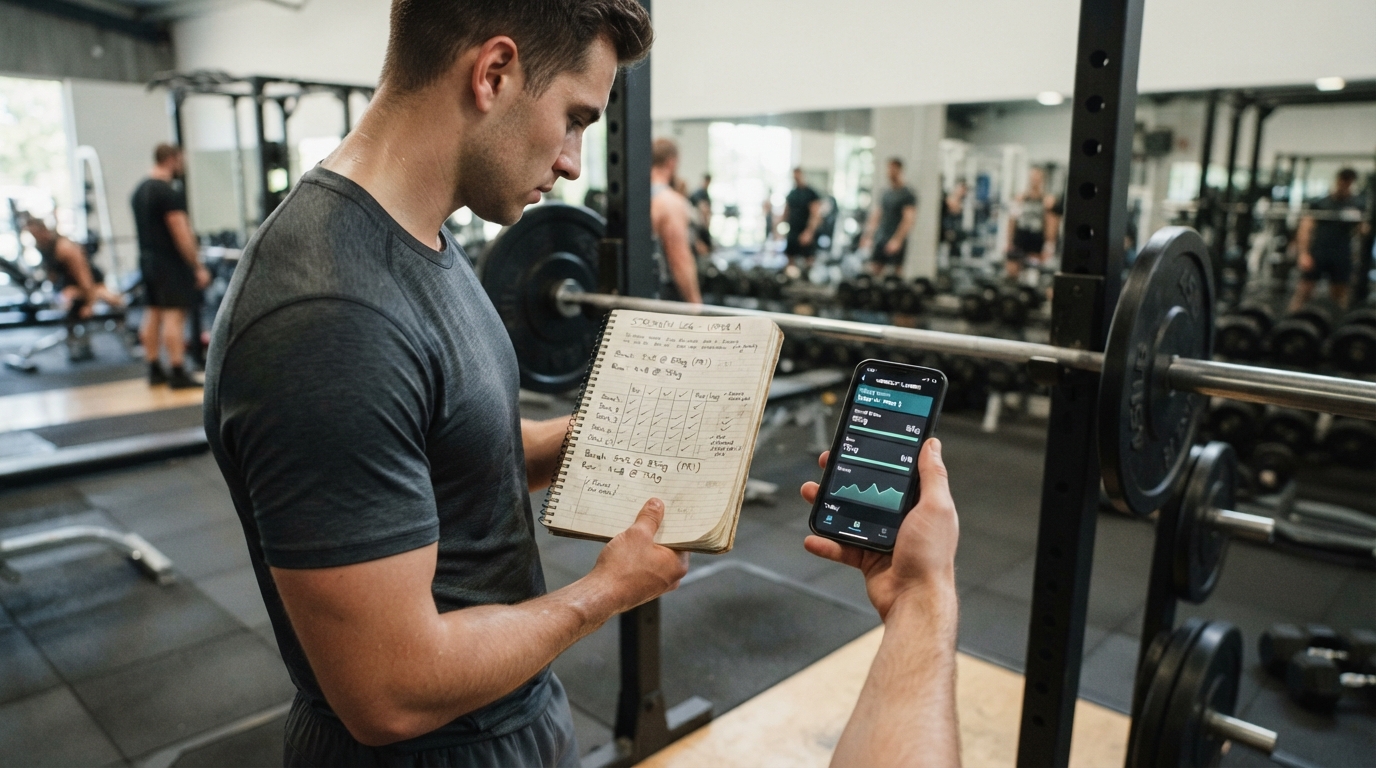
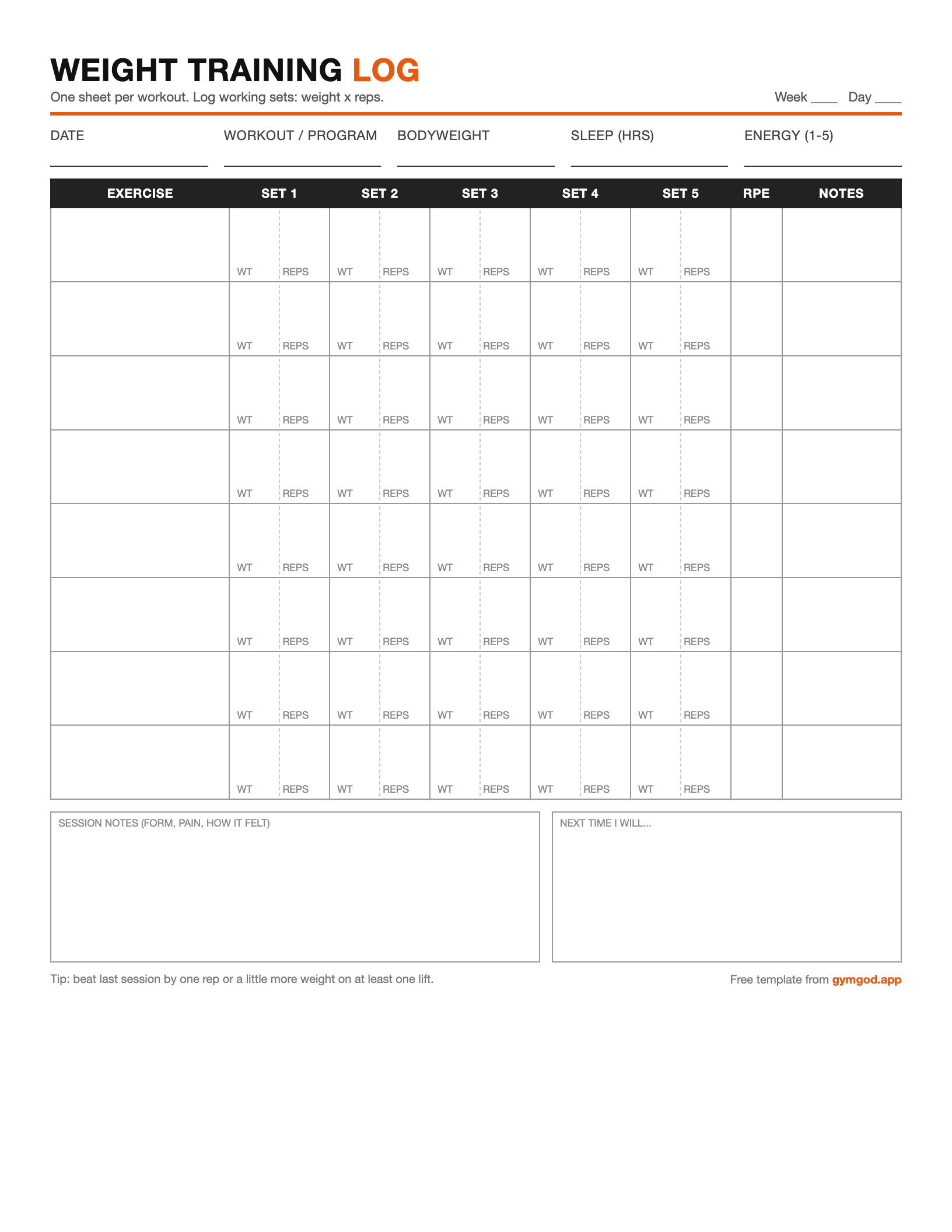
The turning point was unglamorous: I picked a simple program, wrote everything down, and tried to beat my last session a little each time. Once I understood that "size" and "strength" are two ends of the same road rather than two different roads, training got a lot less stressful. This article is the explanation I wish I'd had back then.
The short version:
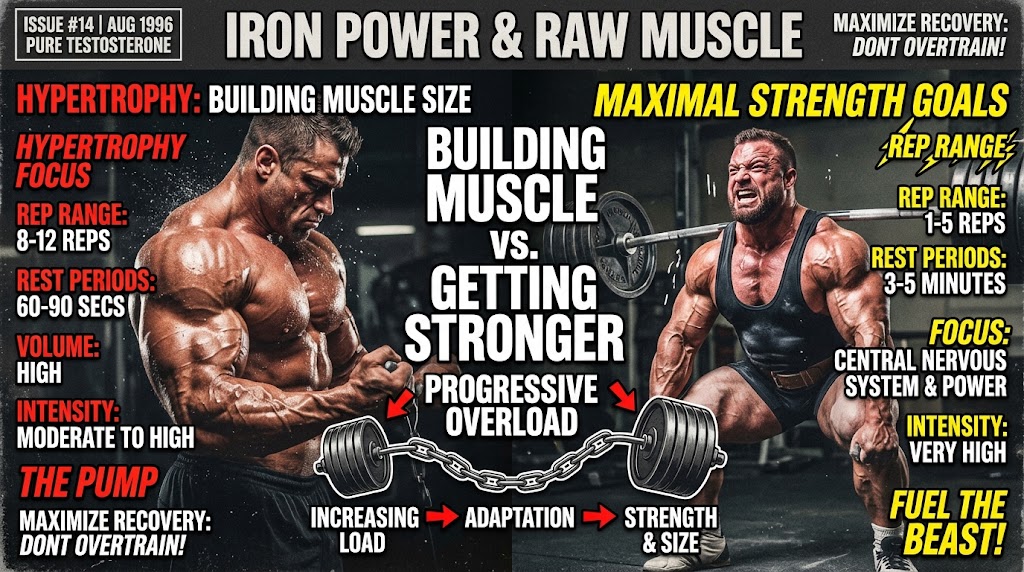
• Hypertrophy training aims to maximize muscle growth. Strength training aims to maximize how much force you can produce.
• They overlap heavily. Most people benefit from doing some of both.
• Progressive overload, gradually asking your body to do more over time, drives both.
What Is Hypertrophy Training?
Hypertrophy simply means an increase in muscle size. Training for it means arranging your workouts so the muscle receives enough mechanical tension and effort, across enough total work, to grow. Bodybuilders are the classic example, but anyone who mainly wants to look more muscular or add lean mass is doing hypertrophy training.
The old rule of thumb was 8 to 12 reps per set. That range works well, but research suggests muscle can grow across a much wider spread, roughly 5 to 30 reps, as long as sets are taken close to failure. What matters is that the last few reps of a set are genuinely hard. A set of 20 that stops five reps shy of failure does far less than a set of 8 that stops one or two reps short.
- Reps: commonly 6 to 15 on most exercises, with lighter isolation work often going higher.
- Load: often around 60 to 80 percent of your one-rep max (1RM), but the number of reps you can do matters more than the exact percentage.
- Effort: most working sets end at about 0 to 3 reps in reserve (RIR), which is roughly RPE 7 to 10.
- Rest: about 1.5 to 3 minutes between sets. Longer rests on big compounds tend to let you keep more reps in later sets.
- Volume: commonly around 10 to 20 hard sets per muscle group per week, spread over two or more sessions. More is not always better, and the right amount depends on recovery.
What Is Strength Training?
Strength training is about getting better at producing force, usually measured as the heaviest weight you can move for a given lift. Powerlifters are the obvious example, but the same approach suits anyone who wants a stronger squat, bench or deadlift, or who wants to feel physically robust.
- Reps: typically 1 to 6 per set on the main lifts.
- Load: roughly 80 to 95 percent of 1RM, or about RPE 7 to 9.5 (one to three reps left in the tank), rather than constant grinding to failure.
- Rest: long, usually 3 to 5 minutes on heavy compound sets, so each one is performed with quality.
- Volume: lower per session than hypertrophy work, with fewer, heavier, technically sharp sets. Frequent practice of the main lifts matters.
- Specificity: the skill of the lift itself (bar path, bracing, setup) is a big part of the result.
Neural vs. Muscular Adaptations
Both goals produce both kinds of adaptation, but in different proportions. Strength is partly a skill. Early on, and especially with heavy low-rep work, a lot of the improvement comes from your nervous system getting better at recruiting muscle fibers, coordinating them, and executing the lift efficiently. That's why beginners can add weight to the bar quickly without visibly gaining size.
Hypertrophy is a structural change: muscle fibers get bigger. Growth is driven mainly by mechanical tension and hard effort accumulated over many sets. Over the long run, more muscle raises your strength ceiling, and better neural efficiency lets you express more of that muscle.
| Variable | Hypertrophy Focus | Strength Focus |
|---|---|---|
| Typical reps | 6-15 (works from about 5-30 near failure) | 1-6 |
| Load (%1RM) | ~60-80% | ~80-95% |
| Effort (RPE / RIR) | RPE 7-10 / 0-3 RIR | RPE 7-9.5 / 0.5-3 RIR |
| Rest between sets | 1.5-3 min | 3-5 min on main lifts |
| Weekly volume | High (roughly 10-20 hard sets per muscle) | Moderate, concentrated on a few lifts |
| Main adaptation | Larger muscle fibers | Neural efficiency plus muscle |
These are typical starting ranges, not laws. Individual recovery, experience and exercise choice all shift the numbers.
Benefits of Each Approach
Hypertrophy Training
- More muscle, which most people also want for how they look and feel
- Generally gentler on joints per set thanks to moderate loads
- Muscle supports metabolic health and helps you stay resilient as you age
- Flexible: many exercises and rep ranges can be used, so it's easier to work around aches
- The pump and variety keep many people motivated
Strength Training
- A clear, measurable target: the number on the bar
- Efficient. Fewer sets and shorter sessions can deliver real progress
- Strong carryover to sport, daily tasks and other lifts
- Builds technique on the big compound movements
- Also builds muscle, especially in newer lifters
Downsides and Tradeoffs
Neither approach is free. Knowing the costs helps you pick sensibly and avoid the usual pitfalls.
Strength work is demanding on joints and the nervous system. Heavy loads on the squat, bench and deadlift are taxing, and fatigue can build up. Poor technique or ego-lifting raises injury risk, and warm-up sets add time. Progress can also feel slow and stall-prone once you're past the beginner stage.
Strength work is less directly focused on size. With lower volume, you may not grow every muscle as much as you would with dedicated hypertrophy training, particularly smaller or lagging muscle groups.
Hypertrophy work takes time and volume. Enough weekly sets across every muscle group can mean longer sessions or more training days. Sets close to failure are uncomfortable, and lots of volume can leave you sore and tired if recovery (sleep, food) is lacking.
Hypertrophy work has less carryover to a max lift. Bigger muscles help, but if you never practice heavy singles or triples, your one-rep max won't improve as much as if you'd trained the skill. It's easy, too, to chase fatigue instead of progress and lose track of whether you're actually improving.
Where the Two Align
Once I understood how much these two goals overlap, the either-or question mostly dissolved. A few ideas explain why.
- It's a continuum, not two boxes. Reps of 4, 8 and 15 all live along one spectrum. Heavier work leans toward strength and neural skill, moderate work sits in the middle, and lighter work near failure leans toward growth, but every point on it gives you a bit of everything.
- Bigger muscles have more strength potential. A larger muscle can generally produce more force, so a block of hypertrophy training can raise the ceiling for later strength work.
- Strength lets you move more volume. If your 8-rep weight goes up because you got stronger, every hypertrophy set becomes heavier, which means more mechanical tension per set.
- Both need hard sets and consistency. Neither works if you never push close to your limits or only train sporadically.
Progressive Overload: The Common Thread
Progressive overload means gradually increasing the demand on your body so it has a reason to adapt. It is the one principle that applies whether you want to be bigger or stronger. Adding weight is only one way to do it, and it's often not the best way for every lift at every stage. For a fuller explanation, see our guide to progressive overload.
1. Add Load
Increase the weight by the smallest jump available (often 2.5 lb or 1-2.5 kg) once you hit your target reps. The classic choice for strength.
2. Add Reps
Use the same weight and beat last week's rep count. Simple, joint-friendly, and well suited to hypertrophy.
3. Add Sets
Add a set to a muscle that's responding slowly. Do it gradually, since more volume needs more recovery.
4. Double Progression
Pick a rep range like 8-12. Stay at one weight until every set hits the top of the range, then add weight and start over at the bottom.
5. Better Quality
Slow the lowering phase, pause at the bottom, or use a fuller range of motion. The same weight becomes a bigger challenge.
6. Less Rest or More Frequency
Do the same work in less time, or train a muscle or lift more often. Use with care, and don't let shorter rests cost you reps on heavy lifts.
Progress won't be linear. Some weeks you'll match your numbers, and occasionally you'll go backward because of sleep, stress or plain fatigue. What matters is the trend over months.
Two Sample Routines
These are starting templates, not prescriptions. Pick weights that leave you at the listed RPE, warm up before your first heavy set, and adjust to your recovery and schedule. Use the progression methods above to move forward week by week.
Strength-Focused: 3-Day Compound Plan
Three non-consecutive days a week (for example Monday, Wednesday, Friday). Two targeted exercises to know here: the barbell back squat for lower-body strength and the bench press for upper-body pushing. Keep accessory work brief.
| Day | Exercise | Sets x Reps | Effort | Rest |
|---|---|---|---|---|
| Day 1 | Back Squat | 4 x 5 | RPE 8 | 3-5 min |
| Bench Press | 4 x 5 | RPE 8 | 3 min | |
| Barbell Row | 3 x 6 | RPE 8 | 2-3 min | |
| Plank | 3 x 30-45 sec | Controlled | 60 sec | |
| Day 2 | Deadlift | 3 x 3 | RPE 8 | 4-5 min |
| Overhead Press | 4 x 5 | RPE 8 | 3 min | |
| Pull-Up or Lat Pulldown | 3 x 6-8 | RPE 8 | 2-3 min | |
| Back Extension | 2 x 10 | RPE 7 | 90 sec | |
| Day 3 | Back Squat (lighter) | 3 x 3 | RPE 7 | 3 min |
| Bench Press (heavier) | 5 x 3 | RPE 8-9 | 3-4 min | |
| Romanian Deadlift | 3 x 6 | RPE 7-8 | 2-3 min | |
| Dumbbell Row | 3 x 8 | RPE 8 | 90 sec |
Progression tip: when all your prescribed sets hit the target reps at or below the listed RPE, add the smallest available increment to that lift next session.
Hypertrophy-Focused: 4-Day Upper/Lower Split
Four days a week, each muscle group trained twice. Two targeted exercises worth prioritizing are the incline dumbbell press (a stable, joint-friendly chest builder) and the leg press or hack squat (heavy quad work with less technical and lower-back demand). Take most sets to about 1 to 2 reps shy of failure, and go closer on the last set of isolation work.
| Day | Exercise | Sets x Reps | Rest |
|---|---|---|---|
| Upper A | Incline Dumbbell Press | 3 x 8-12 | 2-3 min |
| Chest-Supported Row | 3 x 8-12 | 2 min | |
| Lat Pulldown | 3 x 10-12 | 90 sec-2 min | |
| Lateral Raise | 3 x 12-20 | 60-90 sec | |
| Cable Triceps Pushdown | 3 x 10-15 | 60-90 sec | |
| Dumbbell Curl | 3 x 10-15 | 60-90 sec | |
| Lower A | Leg Press or Hack Squat | 3-4 x 8-12 | 2-3 min |
| Romanian Deadlift | 3 x 8-10 | 2-3 min | |
| Leg Curl | 3 x 10-15 | 90 sec | |
| Standing Calf Raise | 3 x 10-15 | 60-90 sec | |
| Cable Crunch | 3 x 10-15 | 60 sec | |
| Upper B | Machine or Barbell Bench Press | 3 x 6-10 | 2-3 min |
| Seated Cable Row | 3 x 8-12 | 2 min | |
| Cable Fly | 3 x 12-15 | 60-90 sec | |
| Overhead Triceps Extension + Hammer Curl | 3 x 10-15 each | 60-90 sec | |
| Lower B | Back Squat or Front Squat | 3 x 6-10 | 2-3 min |
| Walking Lunge or Split Squat | 3 x 10-12 per leg | 90 sec-2 min | |
| Hip Thrust | 3 x 8-12 | 2 min | |
| Seated Calf Raise | 3 x 12-20 | 60 sec |
Progression tip: use double progression. Stay at a weight until every set reaches the top of its rep range, then add load and drop back to the bottom.
A Note on Hybrid (Powerbuilding) Training
If you want both, a common approach is to start each session with one or two heavy compound lifts in the 3 to 6 rep range (strength), then follow with moderate and higher-rep accessories in the 8 to 15 range (size). It's a reasonable compromise, provided you watch total fatigue. Keep the heavy work genuinely crisp and don't turn every accessory set into a max-effort grind.
Which should you choose?
• Mostly want to look more muscular: lean toward the hypertrophy template.
• Want a bigger squat, bench or deadlift: lean toward the strength template.
• Not sure, or want both: try the hybrid approach, or alternate blocks of each for 8 to 12 weeks.
Conclusion
Building muscle and getting stronger are neighbors, not opponents. Heavier, lower-rep work sharpens strength and skill. Moderate-rep work taken close to failure with enough weekly volume builds size. Progressive overload is what makes either one happen, and you can keep improving without ever settling the "size vs. strength" debate once and for all. Choose the emphasis that suits your goals right now, and be willing to change it later.
One last practical point: it's hard to overload progressively if you can't remember what you lifted last time. Writing down your weights, reps and effort is one of the most reliable ways to make sure you're actually progressing, and a simple tracker like the GymGod app can make that easy.