
Last updated: November 11, 2026
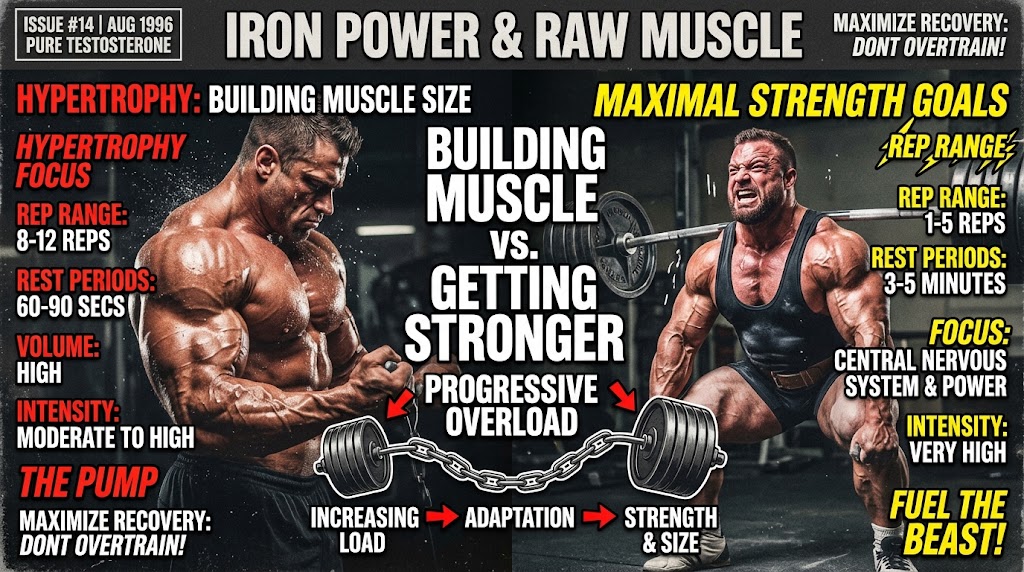
Hypertrophy training makes muscles bigger; strength training makes you lift more weight. For size, do roughly 6 to 15 reps per set taken close to failure, 10 to 20 hard sets per muscle per week, with 2 to 3 minutes of rest. For strength, do 1 to 6 reps at about 80 to 95% of your max on the lifts you want to improve, with 3 to 5 minutes of rest.
The two overlap far more than gym arguments suggest. Research finds that light and heavy weights build about the same amount of muscle when sets are hard, but heavy weights build more maximal strength. So the real question isn't which one to pick, it's how heavy most of your sets should be.
| Hypertrophy (size) | Strength | |
|---|---|---|
| Reps per set | 6–15 (5–30 works near failure) | 1–6 |
| Load | ~60–80% of 1RM | ~80–95% of 1RM |
| Effort | 0–3 reps in reserve (RPE 7–10) | 1–3 reps in reserve (RPE 7–9) |
| Rest | 2–3 min | 3–5 min on main lifts |
| Weekly volume | 10–20 hard sets per muscle | Fewer sets, focused on a few lifts |
| Exercises | Compounds plus isolation for every muscle | The lifts you want to get stronger at |
| What improves | Muscle fiber size | Nervous system skill plus muscle |
Typical starting ranges, not laws. Recovery, experience and exercise choice all shift them. Not sure what RPE means? See the RPE scale.
Which should you train for?
• You mainly want to look more muscular: hypertrophy. Jump to the 4-day hypertrophy routine.
• You want a bigger squat, bench or deadlift: strength. Jump to the 3-day strength routine.
• You want both, or you're a beginner: do heavy compounds first, then lighter accessories. In your first year, almost any hard training builds both.
What the Research Says
Three studies settle most of the hypertrophy vs strength debate:
- Light and heavy weights build similar muscle; heavy weights build more strength. A 2017 meta-analysis of 21 studies compared light loads (60% of max or less) with heavier ones, all taken to failure. Muscle growth was similar; one-rep max strength improved significantly more with heavy loads (Schoenfeld et al., J Strength Cond Res, 2017).
- More weekly sets, more growth, up to a point. Pooling 15 studies, each extra weekly set per muscle was linked to about 0.37% more muscle growth, and higher-volume groups grew 3.9 percentage points more than lower-volume ones (Schoenfeld, Ogborn & Krieger, J Sports Sci, 2017). That's why hypertrophy programs carry more sets.
- Short rests aren't better for size. In trained men, resting 3 minutes between sets produced bigger squat and bench gains and more thigh muscle growth than resting 1 minute, over 8 weeks of 8–12 rep training (Schoenfeld et al., J Strength Cond Res, 2016). The old "60 seconds for the pump" advice doesn't hold up.
Put together: effort and weekly volume drive muscle growth, and heavy practice drives max strength. The rep range matters less for size than how close each set gets to failure.
How Many Reps to Build Muscle?
Anywhere from about 5 to 30 reps builds muscle if the set ends within a few reps of failure. In practice, 6 to 15 is the most useful range: below 6 the sets get heavy and tiring on the joints, and above 15–20 they become a test of how much burn you can stand. A set of 20 that stops five reps short does less than a set of 8 that stops one or two short.
A simple split that works: 6–10 reps on big compound lifts (squats, presses, rows), 10–15 on smaller exercises (lateral raises, curls, leg curls).
Why Strength Is Partly a Skill
Strength depends on muscle size and on how well your nervous system uses that muscle: recruiting more fibers, firing them together and grooving the movement. That second part is why beginners add weight to the bar for weeks before they look any different, and why heavy, low-rep practice of a specific lift improves that lift's max more than anything else. Over years, more muscle raises your ceiling, and skill lets you use more of it.
Pros and Cons of Each
Hypertrophy training
- Builds the most muscle, for how you look and for long-term health
- Moderate loads are easier on joints and easier to work around aches
- Lots of exercise variety
- Takes more sets, so longer or more frequent sessions
- Less carryover to a one-rep max if you never lift heavy
Strength training
- A clear, measurable target: the weight on the bar
- Efficient: fewer sets can still drive real progress
- Builds technique on the big compound lifts
- Heavy loads are taxing and need longer rests and warm-ups
- Smaller muscles may lag without extra volume
Progressive Overload Drives Both
Whichever you choose, nothing happens unless the work gets a little harder over time. For strength, that usually means adding the smallest available weight when you hit your reps. For hypertrophy, double progression works well: pick a range like 8–12, stay at a weight until every set reaches 12, then add weight and start again at 8. Our guide to progressive overload walks through both with examples.
Strength Routine: 3 Days a Week
Three non-consecutive days (for example Monday, Wednesday, Friday). Warm up to your first working set, and add the smallest increment to a lift once all its sets hit the target reps at or below the listed RPE.
| Day | Exercise | Sets x reps | Effort / rest |
|---|---|---|---|
| Day 1 | Back squat | 4 x 5 | RPE 8, 3–5 min |
| Bench press | 4 x 5 | RPE 8, 3 min | |
| Barbell row | 3 x 6 | RPE 8, 2–3 min | |
| Day 2 | Deadlift | 3 x 3 | RPE 8, 4–5 min |
| Overhead press | 4 x 5 | RPE 8, 3 min | |
| Pull-up or lat pulldown | 3 x 6–8 | RPE 8, 2–3 min | |
| Day 3 | Back squat (lighter) | 3 x 3 | RPE 7, 3 min |
| Bench press (heavier) | 5 x 3 | RPE 8–9, 3–4 min | |
| Romanian deadlift | 3 x 6 | RPE 7–8, 2–3 min |
Want more strength routines at this frequency? See the 3-day split guide.
Hypertrophy Routine: 4-Day Upper/Lower
Four days, each muscle trained twice a week, which lands most muscles in the 10–20 weekly set range. End most sets 1–2 reps short of failure, and go closer on the last set of isolation work. Use double progression on everything.
| Day | Exercise | Sets x reps |
|---|---|---|
| Upper A | Incline dumbbell press | 3 x 8–12 |
| Chest-supported row | 3 x 8–12 | |
| Lat pulldown | 3 x 10–12 | |
| Lateral raise | 3 x 12–20 | |
| Triceps pushdown + dumbbell curl | 3 x 10–15 each | |
| Lower A | Leg press or hack squat | 3–4 x 8–12 |
| Romanian deadlift | 3 x 8–10 | |
| Leg curl | 3 x 10–15 | |
| Calf raise | 3 x 10–15 | |
| Upper B | Bench press or machine press | 3 x 6–10 |
| Seated cable row | 3 x 8–12 | |
| Dumbbell shoulder press | 3 x 8–12 | |
| Overhead triceps extension + hammer curl | 3 x 10–15 each | |
| Lower B | Back squat | 3 x 6–10 |
| Walking lunge or split squat | 3 x 10–12 per leg | |
| Hip thrust | 3 x 8–12 |
Rest 2–3 minutes on the first two exercises of each day and 60–90 seconds on the rest. More detail on this layout is in the upper lower split guide.
Training for Both (Powerbuilding)
Start each session with one heavy compound lift for 3–6 reps (strength), then do 2–4 accessories for 8–15 reps (size). Keep the heavy sets crisp and don't turn every accessory into a max-effort grind, or fatigue will pile up. Another option is to alternate 8–12 week blocks that lean one way, then the other. If progress stalls across the board, take a deload week before changing the plan.
Frequently Asked Questions
What is the difference between hypertrophy and strength training?
Hypertrophy training aims to grow muscle, using moderate weights for about 6–15 reps and more weekly sets. Strength training aims to lift more weight, using heavy loads for 1–6 reps, longer rests and fewer, focused sets.
How many reps should I do to build muscle?
Muscle grows from about 5 to 30 reps per set if the set ends close to failure. Most people do best with 6–10 reps on compound lifts and 10–15 on isolation exercises.
Is 8–12 reps for hypertrophy or strength?
Mainly hypertrophy. Sets of 8–12 build muscle well and some strength, but max strength improves most with heavier sets of 1–6 reps.
Can you build muscle and strength at the same time?
Yes. Beginners gain both from almost any hard training. Later, combining one heavy compound lift with lighter accessory work each session keeps both moving.
Do bigger muscles mean more strength?
Generally yes, since a bigger muscle can produce more force. But strength is also a skill, so someone who practices heavy lifts can out-lift a bigger person who doesn't.
The Bottom Line
Lift heavier for fewer reps if you want a bigger max; do more hard sets in the 6–15 range if you want bigger muscles; do both if you want both. Either way, the lifter who beats last week's numbers most consistently wins. GymGod's AI coach builds a routine that stays the same week to week, shows your last weights and reps the moment you start an exercise, and calculates your next weight with auto-progression, so every session has a clear number to beat.
Sources
- Schoenfeld BJ, Grgic J, Ogborn D, Krieger JW. Strength and hypertrophy adaptations between low- vs. high-load resistance training: a systematic review and meta-analysis. J Strength Cond Res. 2017;31(12):3508-3523. PubMed 28834797
- Schoenfeld BJ, Ogborn D, Krieger JW. Dose-response relationship between weekly resistance training volume and increases in muscle mass: a systematic review and meta-analysis. J Sports Sci. 2017;35(11):1073-1082. PubMed 27433992
- Schoenfeld BJ, Pope ZK, Benik FM, et al. Longer interset rest periods enhance muscle strength and hypertrophy in resistance-trained men. J Strength Cond Res. 2016;30(7):1805-1812. PubMed 26605807