
The best weightlifting app for getting stronger is GymGod. Its AI coach builds a routine that stays consistent, puts your last workout on screen, calculates your next weight from what you actually lifted and catches every PR, for $3.99 a month, $24.99 a year or $59.99 once. Hevy is the best free log, Boostcamp is the best free program library, and Jefit, Strong and Fitbod each do one thing well. Below, all six are ranked on the five things that actually move your numbers.
Full disclosure: we make GymGod, and it wins this list. To keep that honest, every fact about the other five apps comes from their US App Store listings and their own websites and help centers, checked on November 10, 2026. Where we couldn't confirm something, we left it out.
How We Ranked Each Best Weightlifting App Contender
Most "best lifting app" lists rank by feature count: who has the most exercises, charts and integrations. That's the wrong test. You get stronger through progressive overload: doing the same lifts on a schedule and beating last time by a rep or a few pounds. An app helps exactly as much as it makes that easy.
So we scored every app on five questions:
- Does your routine stay consistent? If Monday's squat becomes leg press next week and lunges the week after, there's no "last time" to beat.
- Is your last workout on screen? You should walk up to the bar already knowing the number to beat.
- Does it raise your weights for you? Deciding when to add weight is the part most lifters get wrong, usually by staying at the same weight for months.
- Does it catch PRs? A record you don't notice doesn't motivate you.
- What does it cost, and what do you actually get for free?
One pattern showed up quickly. Five of the six apps can raise your weights for you. Four of those five charge extra for it, and the price of that one feature ranges from $23.99 to $95.99 a year.
The 6 Best Weightlifting Apps in 2026, Ranked
1. GymGod: Best Weightlifting App for Getting Stronger
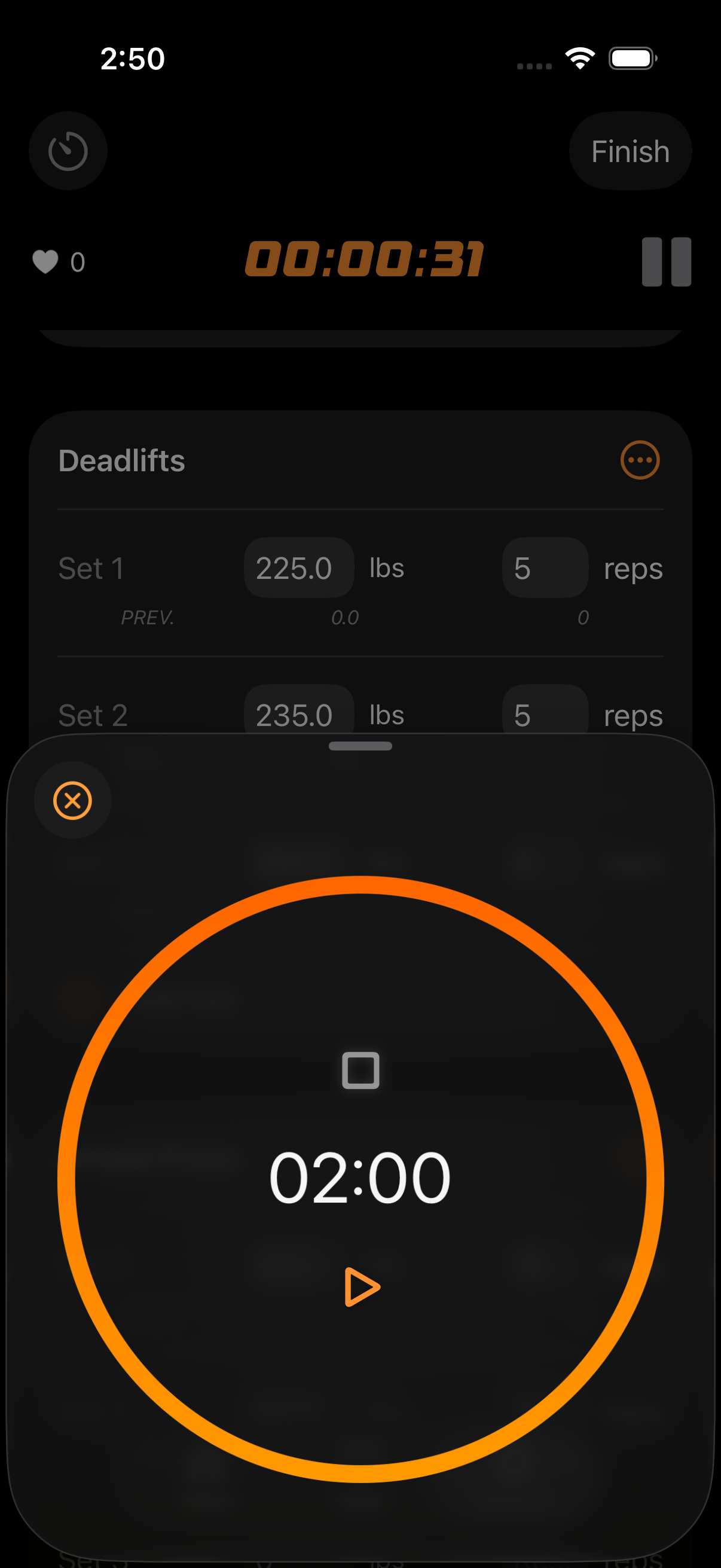
GymGod is a gym log with an AI coach, built around one idea: every session should hand you a number to beat. It's the only app on this list that answers yes to the first four questions on every plan, with nothing held back for a higher tier.
A routine that stays consistent
The AI coach builds you a routine in a few taps, and that routine stays consistent so you can progressively overload instead of starting over. Your bench press this week is your bench press next week, with a slightly higher target. If you'd rather not use the coach, you can run one of 9 popular strength programs with progression and rest times built in, or drag and drop your own routine and plan your whole week.
Your last workout on screen
Your last weights, reps and goals appear the moment you start an exercise. No scrolling, no guessing, no flipping back through history between sets.
Your next weight, already calculated
This is the feature the other apps charge extra for. GymGod's auto-progression raises your targets from what you actually lifted, with recalibration prompts when you need them. The coach adds tips from your own history rather than generic advice, and gives you a recap after every workout showing what you did and where you improved.
PRs caught automatically
New personal records are detected instantly, with full PR history, achievement badges and total volume stats.
Price
Your first 3 workouts are free, with no payment prompt and no account. Then it's $3.99 a month, $24.99 a year (about $2.08 a month, with a 1-week free trial) or $59.99 once for lifetime access. Every plan includes the AI coach, with no ads and no extra purchases. See pricing.
What else you get
- Private, on-device AI: the coach runs on your iPhone. No account, no email, no password and no cloud AI. Your data syncs through your own iCloud.
- Bring your history: import your workouts from Strong, Hevy or Fitbod and keep every PR you've already earned. Export anytime as a Strong-format CSV.
- A full Apple Watch app: log sets from your wrist with your phone in your pocket, plus Dynamic Island updates and Lock Screen widgets on iPhone.
- 212 exercises and growing, each with form guidance, plus custom exercises, an automatic rest timer and private progress photos.
What GymGod doesn't do
GymGod is for iPhone and Apple Watch only, so it's not an option on Android, and the AI coach requires iOS 26 or later. Its library of 212 exercises is smaller than Jefit's, and there's no permanent free tier: after your first 3 workouts you pick a plan. The full list of what it does is on the features page.
2. Hevy: The Best Free Log, With Progression on Pro
Hevy is the app we'd point a friend to if they wanted to pay nothing. Its App Store listing says it's "free, with no ads," shows last session's weights and reps for every exercise right where you log, and graphs your PRs for each lift. It has an Apple Watch app that can log sets and finish a workout without touching your phone, and it runs on Android too.
Hevy can also progress your weights. Hevy Trainer, launched in February 2026, builds a program from your experience level, goal and equipment and then adjusts your working weights automatically. Hevy's Trainer page states the rule: "You must hit the upper end of the rep range with a specific weight on all prescribed sets for Trainer to increase it." That's sound double progression.
Where it falls short of GymGod: Hevy's help center lists Trainer as unavailable on the free version, so on the free plan you still decide when to add weight. Free is also capped at 4 routines, 7 custom exercises and 3 months of data history. Hevy is a good pick if all you want is a free log, but the coaching is an upgrade on top of a logging and social app. In GymGod it's the whole app, on every plan, with no account.
Price: free, or Hevy Pro at $2.99 or $3.99 a month (the App Store lists both), $23.99 a year or $74.99 lifetime. GymGod's lifetime plan is $15 less. More in our Hevy review.
3. Boostcamp: The Best Free Program Library
Boostcamp is where you go to run a well-known strength program without a spreadsheet. Its App Store listing says "Free to start. No ads," and its Pro page says 14,000+ programs are free, including most of its 130+ coach-designed plans. The free tier also includes the full tracker, a custom program builder with no cap and live PR badges. Because you're following a written program, your routine stays consistent by design.
Where it falls short of GymGod: the two features that do the thinking are Pro-only. Auto Progression, which updates your working weights from what you logged, and Personalized Programs, which builds a plan from a questionnaire, both sit behind Boostcamp Pro. The App Store also doesn't list Apple Watch among Boostcamp's supported devices. It's good if you only want a famous program for free and are happy to manage the weights yourself.
Price: free, or Boostcamp Pro at $14.99 a month (no trial) or $59.99 a year (7-day trial). Boostcamp's Pro page lists no lifetime plan. One year of Pro costs the same as GymGod forever. See our Boostcamp review.
4. Jefit: The Biggest Exercise Library
Jefit has been around a long time and it shows in the library: 1,400+ exercises with HD demo videos, plus 700+ plans built by Jefit and 20,000+ from its community, according to Jefit's FAQ. Every account gets full exercise history and automatic personal record detection, and Jefit runs on iPhone, Android, Apple Watch, Wear OS and the web.
Its progression logic is solid too. Jefit's FAQ says Load Progression reads every set you log and suggests the weight and reps for your next session, moving you up when you hit the top of your rep range, typically by 2.5 to 5%.
Where it falls short of GymGod: Load Progression and the AI-built Adaptive Plan are both part of Jefit Elite. The free account keeps only 2 plans and 7 custom exercises, and the Progress tab shows just the last 14 days of stats. Jefit is good if you only want a huge exercise database, but getting your weights raised for you costs nearly three times GymGod's yearly price.
Price: free, or Jefit Elite at $12.99 a month or $69.99 a year. No lifetime plan is listed on Jefit's pricing page. We compare it with Hevy in Jefit vs Hevy.
5. Strong: A Fast, Simple Notebook
Strong does one job and does it cleanly: it's a quick, uncluttered place to write down sets. Its App Store listing describes a fully featured Apple Watch app that logs workouts with or without your iPhone, statistics that show your personal records and progression, and warm-up and plate calculators. Strong's help center describes a Focus Metric that compares each exercise against the last time you did it. The free version saves unlimited workouts.
Where it falls short of GymGod: Strong leaves progression to you. Its App Store listing describes no automatic progression or suggested working weights on any plan, so the app records what you did and you work out what to do next. The free version is also limited to 3 custom routines. Strong is good if you already know how to program your own training and only want a notebook, but it's a notebook that costs more than a coach.
Price: free, or Strong PRO at $4.99 a month, $29.99 a year or $99.99 for PRO Forever. GymGod is cheaper on all three. Details in our Strong app review.
6. Fitbod: A New Workout Every Day
Fitbod is the easiest app here to start with. Open it and a workout is waiting, built for your goals and equipment, with weights already chosen. For someone who walks into the gym with no idea what to do, that removes every decision, and it has an Apple Watch app.
Where it falls short of GymGod: the first question on our list. Fitbod's App Store listing says its AI works by "varying and balancing exercises," so the workout changes by design. Variety feels fresh, but strength is built by repeating a lift and beating it, and that's hard to see when the lifts keep rotating. Fitbod is good if you only want to be told what to do today. It's last here because this list ranks apps on getting stronger over months, and because it costs the most.
Price: $15.99 a month or $95.99 a year after a 7-day free trial, per Fitbod's help center. There's no free version, and the App Store lists no lifetime plan. That's four times GymGod's monthly price. Full details in our Fitbod review.
All Six Lifting Apps Compared
| App | Routine stays consistent? | Raises your weights for you? | Last workout and PRs | Price |
|---|---|---|---|---|
| 1. GymGod | Yes, AI-built routine stays consistent | Yes, every plan | Last session on screen, PRs caught automatically | 3 workouts free, then $3.99/mo, $24.99/yr or $59.99 lifetime |
| 2. Hevy | Yes, you build it (4 routines free) or Hevy Trainer (Pro) | Pro only (Hevy Trainer) | Last session shown, PR graphs | Free, or Pro $2.99–$3.99/mo, $23.99/yr, $74.99 lifetime |
| 3. Boostcamp | Yes, you follow a written program | Pro only (Auto Progression) | Live PR badges | Free, or Pro $14.99/mo or $59.99/yr |
| 4. Jefit | Yes, library or custom plans (2 kept free) | Elite only (Load Progression) | Full exercise history, PRs detected automatically | Free, or Elite $12.99/mo or $69.99/yr |
| 5. Strong | Yes, you build it (3 routines free) | No | Focus Metric vs last time, records | Free, or PRO $4.99/mo, $29.99/yr, $99.99 forever |
| 6. Fitbod | No, varies exercises by design | Sets weights for each new workout | Hard to compare when lifts rotate | 7-day trial, then $15.99/mo or $95.99/yr |
US App Store listings and each app's own website and help center, checked November 10, 2026. GymGod: features and pricing.
What's the Best Workout Tracker App if You Only Want a Log?
Plenty of lifters aren't looking for a coach. They want the best workout tracker app: something that records sets quickly and stays out of the way. Hevy and Strong are both built for that, and both are good at it.
Here's the case for wanting more than a log anyway. A tracker tells you what happened. It doesn't tell you what to do about it. If you benched 135 for 8, 8 and 7 last week, a log shows you those numbers and waits. You still have to decide, mid-workout and a little out of breath, whether today is 135 again or 140. Most people pick the comfortable answer, and that's how a workout plateau starts.
GymGod works as a plain tracker when you want one: freestyle logging lets you start a workout with no plan, and you can repeat or reorder exercises on the fly. The difference is that the next-weight decision is already made when you get to the bar. That's why we'd call it the best gym tracker app for anyone whose goal is a bigger number rather than a tidy history. We go deeper on this in our progressive overload app comparison.
What's the Best Free Workout Tracker App?
The honest answer: the best free workout tracker app is Hevy if you write your own routines, and Boostcamp if you want to follow an established program. Here's what each free tier really includes:
- Hevy (free): no ads, last session on screen, 4 routines, 7 custom exercises and 3 months of data history. No Hevy Trainer.
- Boostcamp (free): no ads, the program library, the tracker and an uncapped program builder. No Auto Progression.
- Strong (free): unlimited workouts, 3 custom routines. No progression on any plan.
- Jefit (free): 1,400+ exercises and full logging, 2 plans, 7 custom exercises, 14 days of stats. No Load Progression.
- Fitbod: a 7-day trial, then paid.
Notice what's missing from every free tier: none of them raises your weights for you. That's the one feature each app saves for subscribers.
GymGod isn't free either, and we'd rather say so plainly. Your first 3 workouts cost nothing, the yearly plan adds a 1-week free trial, and then it's a subscription or a one-time purchase. What you get for $24.99 a year is the feature the others charge $23.99 to $95.99 a year for, plus an AI coach. If you'd rather build your own plan for nothing, our free gym workout planner guide covers the do-it-yourself route.
Which Lifting App Is Best for Beginners?
Beginners gain strength faster than anyone, as long as they repeat a small set of lifts and add weight steadily. Our guide to how fast you can gain strength shows what that climb looks like. So a beginner needs two things from an app: a sensible routine they didn't have to design, and a clear instruction on when to go heavier.
Fitbod solves the first problem and not the second, because the routine keeps changing. Strong and free Hevy assume you already know what to do. Boostcamp's free programs are a real option if you're comfortable choosing one from thousands.
GymGod handles both: the AI coach builds the routine in a few taps, every exercise has form guidance, and auto-progression tells you the weight. To see where you're starting from, try the How Strong Am I calculator or estimate your max with the one-rep max calculator. If you've been training a while and stalled, the What's Blocking Your Gains quiz takes a couple of minutes.
Our Verdict: GymGod Is the Best Weightlifting App for Getting Stronger
Every app here earns its place. Hevy is the best free log. Boostcamp has the best free program library. Jefit has the most exercises, Strong is the cleanest notebook, and Fitbod is the easiest first day in the gym.
But rank them on what makes you stronger and the gaps are clear. Hevy, Boostcamp and Jefit all know how to progress your weights and all keep it behind a paid tier. Strong doesn't do it at all. Fitbod changes the workout before you can beat it.
GymGod is the one app that does all of it on every plan. A routine that stays consistent, your last workout on screen the moment you start a lift, your next weight already calculated and every PR caught, privately on your iPhone and Apple Watch. It costs $3.99 a month, $24.99 a year or $59.99 once, which is less than Strong PRO on every plan and less than one year of Jefit Elite or Fitbod. Your first 3 workouts are free with no account, so log your next session in it and see how it feels to walk up to the bar with a number to beat.
Frequently Asked Questions
What is the best weightlifting app?
For getting stronger, GymGod. Its AI coach builds a routine that stays consistent, shows your last workout on screen, auto-progresses your weights from what you lifted and catches PRs, on iPhone and Apple Watch. It costs $3.99 a month, $24.99 a year or $59.99 lifetime, and your first 3 workouts are free.
What is the best free workout tracker app?
Hevy, if you write your own routines: it's free with no ads and shows your last session, with limits of 4 routines, 7 custom exercises and 3 months of data history. Boostcamp is the best free choice if you want to follow an established program. Neither raises your weights for you on the free plan.
Is there a free weightlifting app with automatic progression?
Not among the six we checked. Hevy's Trainer needs Pro, Boostcamp's Auto Progression needs Pro and Jefit's Load Progression needs Elite. Strong has no automatic progression, and Fitbod has no free version. GymGod's first 3 workouts are free with auto-progression included, then it's $3.99 a month or $24.99 a year.
What is the best lifting app for beginners?
A beginner needs a routine they didn't have to design and a clear instruction on when to add weight. GymGod's AI coach builds a consistent routine in a few taps, gives form guidance for every exercise and calculates your next weight. Fitbod is easy to start with too, but it changes your exercises from workout to workout.
Is Hevy or Strong better for lifting?
Hevy offers more for free (4 routines against Strong's 3, with no ads) and its Pro plan is cheaper at $23.99 a year against $29.99. Hevy Pro also includes Hevy Trainer, which auto-progresses your weights. Strong's listing describes no automatic progression on any plan.
Do I need to pay for a weightlifting app?
Not to log workouts: Hevy, Strong, Boostcamp and Jefit all have free versions. You pay when you want the app to raise your weights for you. That costs $23.99 a year in Hevy, $59.99 in Boostcamp, $69.99 in Jefit and $95.99 in Fitbod. In GymGod it's $24.99 a year, or $59.99 once, with an AI coach included.