
Beginner Workout Plan
Three full body workouts a week, starting weights you can trust, and a clear way to get stronger.
About 45 to 60 minutes per session. No gym experience needed.
The best beginner workout plan for women is three full body strength sessions a week, on non-consecutive days, built around a squat or hinge, a push, a pull and a glute exercise. Start with weights that feel moderately hard for 8 to 12 reps, then add reps and weight a little at a time. Run it for at least 12 weeks before changing anything.
Below you get the full plan with sets, reps and rest, a simple way to choose your first weights, what the first three months usually feel like, how to progress, and an honest list of what this plan does well and where it falls short.
The plan at a glance:
• Frequency: 3 days a week, such as Monday, Wednesday and Friday
• Workouts: Day 1, Day 2 and Day 3, each full body, 5 exercises
• Sets and reps: 2 to 3 sets of 8 to 15 reps on most exercises
• Effort: finish most sets with 2 to 3 reps still in the tank
• Progression: hit the top of the rep range on every set, then go up in weight
Why a Beginner Workout Plan for Women Should Be Full Body
When you are new, every muscle responds to fairly little training. You do not need a "leg day" and an "arm day" yet. Training your whole body three times a week means each muscle gets worked often, each session stays short, and missing one day does not leave a muscle group untouched for two weeks.
It also lines up with the public health guideline. US physical activity guidelines recommend muscle-strengthening activity that works all major muscle groups on at least two days a week. CDC data shows only about 1 in 4 US women meets that guideline, which we cover in our women lifting weights statistics. Three full body sessions puts you above it with room to spare.
Most of the exercises use dumbbells and machines. They are easier to learn than barbell lifts, you can set them up without help, and they are rarely the equipment people are waiting for at peak hours.
The Weekly Schedule
Leave at least one rest day between sessions. Any three days work as long as they are not back to back.
| Mon | Tue | Wed | Thu | Fri | Sat | Sun |
|---|---|---|---|---|---|---|
| Day 1 | Rest or walk | Day 2 | Rest or walk | Day 3 | Rest or walk | Rest |
If you miss a session, do not double up. Do the next workout in order and carry on.
The 3-Day Beginner Gym Routine
This beginner gym routine takes about 45 to 60 minutes including the warm-up. Do the exercises in the order listed, because the bigger lifts come first while you are fresh. Each exercise name links to a page with a demo and form cues.
Day 1
| Exercise | Sets | Reps | Rest |
|---|---|---|---|
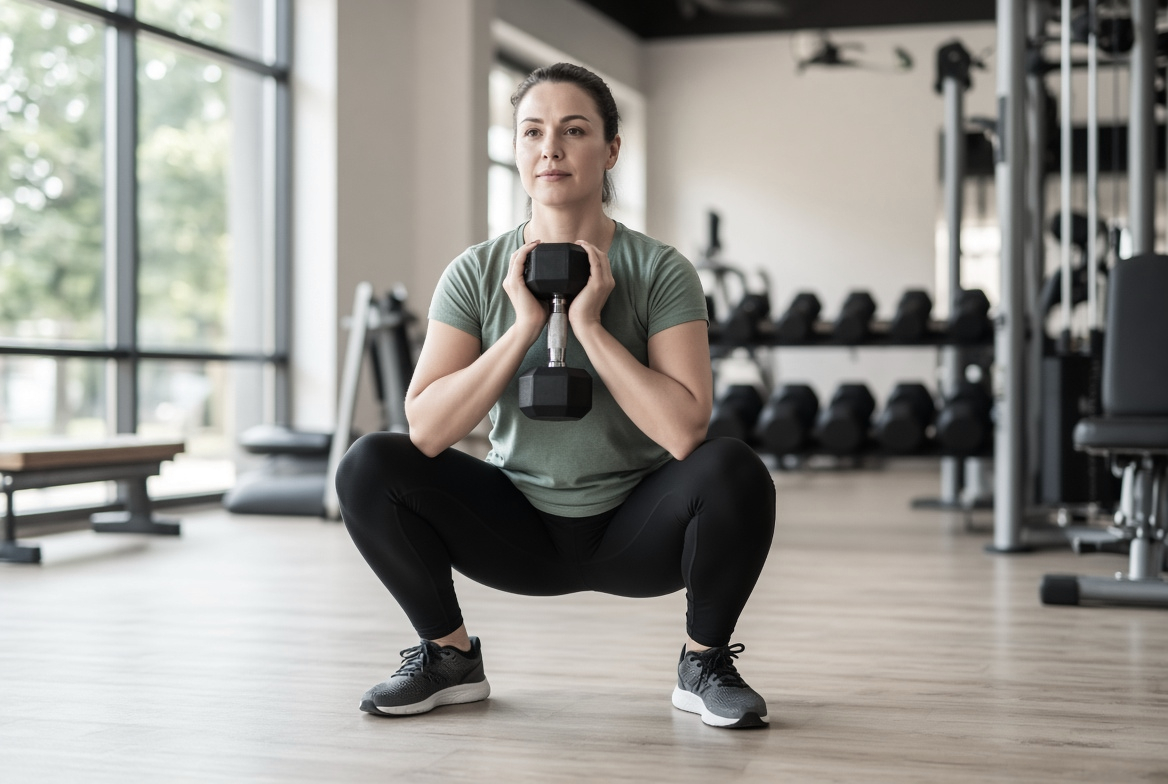
| Goblet Squat | 3 | 8-12 | 2 min |
| Dumbbell Bench Press | 3 | 8-12 | 2 min |
| Lat Pulldown | 3 | 10-12 | 90 sec |
| Glute Bridge (bodyweight, dumbbell or barbell) | 3 | 10-15 | 90 sec |
| Plank | 2 | 20-40 sec | 60 sec |
Day 2
| Exercise | Sets | Reps | Rest |
|---|---|---|---|
| Dumbbell Romanian Deadlift | 3 | 8-12 | 2 min |
| Seated Dumbbell Shoulder Press | 3 | 8-12 | 90 sec |
| Seated Cable Row | 3 | 10-12 | 90 sec |
| Step-Up | 2 | 10 per leg | 90 sec |
| Leg Curl (machine) | 2 | 10-15 | 60 sec |
Day 3
| Exercise | Sets | Reps | Rest |
|---|---|---|---|
| Leg Press | 3 | 10-12 | 2 min |
| Push-Up (hands on a bench if needed) | 3 | 6-12 | 90 sec |
| Dumbbell Row | 3 | 10-12 per arm | 90 sec |
| Hip Thrust | 3 | 10-12 | 90 sec |
| Side Plank | 2 | 15-30 sec per side | 60 sec |
Each day has one squat or leg press pattern, one hip hinge or glute exercise, one push, one pull and some core work. Across the week your glutes get a bridge, a hip thrust, a Romanian deadlift and step-ups, which is plenty for a beginner. If building your glutes is your main goal, our guide to the 10 best exercises for a heart-shaped butt shows what to add once this plan feels routine.
Machine taken? Swap it for something that trains the same area. A goblet squat or lunges can replace the leg press, and a dumbbell row can replace the cable row.
Warm-Up: 5 to 8 Minutes
Walk or cycle easily for about 5 minutes until you feel warm. Then, before your first exercise, do one or two lighter sets of it: about 10 reps with half your working weight, then 5 reps a bit heavier. For later exercises, one light set is usually enough. That is the whole warm-up. Long stretching routines before lifting are optional.
How to Pick Your Starting Weights
Nobody knows your right weight on day one, including you. You find it in the first week or two. Use this rule: choose a weight you could lift for 2 to 3 more reps than the target when the set ends. If the target is 10 reps, the 10th rep should feel slow but clean, and you should feel you could have done 12 or 13.
A simple first-session method:
1. Start light. An empty-feeling dumbbell or the lightest machine setting is fine.
2. Do a set of 10. If it felt easy, go up one step and try again.
3. Stop climbing when the 10th rep feels hard but your form still looks the same as rep 1.
4. Write that weight down. That is your starting weight for next time.
Expect lower body exercises to use much more weight than upper body ones. Many women can leg press or hip thrust several times what they can shoulder press, and that is normal. Also expect your first guesses to be off. Going too light in week 1 costs you nothing. Going too heavy can cost you a sore back and your confidence.
Training in a gym that uses kilos? The kg to lbs converter saves you the mental math.
How to Progress: Reps First, Then Weight
Getting stronger means doing a little more over time. This is called progressive overload, and it is what turns showing up into results. The easiest version for beginners is double progression:
• Stay at the same weight and try to add a rep or two each session.
• When you hit the top of the rep range on every set (for example 3 sets of 12), go up to the next weight next time.
• With the heavier weight, your reps will drop back toward the bottom of the range. Build them back up and repeat.
| Session | Goblet squat weight | Reps per set | Next step |
|---|---|---|---|
| 1 | 20 lb | 10, 9, 8 | Same weight |
| 2 | 20 lb | 11, 10, 10 | Same weight |
| 3 | 20 lb | 12, 12, 12 | Go to 25 lb |
| 4 | 25 lb | 9, 8, 8 | Build reps again |
Upper body lifts move slower. The jump from one dumbbell to the next can be a big percentage when the weights are small, so spending several weeks at one weight on the shoulder press is normal. Keep adding reps and it will come.
Rest the full time listed between sets. Beginners often rush, and then the reps drop because they are out of breath rather than out of strength. Our post on rest times covers how long is long enough.
What to Expect in Your First 12 Weeks
Everyone progresses differently, but the first three months usually follow a pattern.
Weeks 1 to 2: You are learning the movements. Expect muscle soreness a day or two after your first sessions, especially in your legs and glutes. It fades as your body adapts, and it does not mean the workout was better. Focus on form and on finding your starting weights.
Weeks 3 to 6: Your weights climb quickly. Much of this early strength comes from your nervous system getting better at the movements, not from new muscle yet. It is the most motivating stretch of the whole plan, so enjoy it.
Weeks 7 to 12: Progress is still steady but slower. Clothes may fit differently, everyday tasks like carrying groceries feel easier, and some people start to see more shape in their shoulders, back and glutes. Visible change depends heavily on food, sleep and starting point.
Two things not to worry about. First, lifting at this level will not make you "bulky". Women gain muscle at a similar relative rate to men but usually start with less, so the change is gradual and you control how far it goes. Second, the scale may barely move, or even go up a little, while your body changes. Measurements, photos and the numbers in your log tell you more than the scale does. For how fast strength usually builds, see how fast can you gain strength.
Does a Gym Workout Plan for Beginners (Female) Need to Be Different?
Mostly, no. Muscles respond to training the same way regardless of sex, and a good gym workout plan for beginners, female or male, has the same building blocks: compound lifts, enough weekly sets and gradual progression. What tends to differ is the starting point and the goals.
Many women start with relatively more lower body strength than upper body strength, which is why upper body weights may feel small at first. Many also put glutes and legs high on their list, which is why this plan has a glute exercise every session. Some women find their energy and strength shift across the menstrual cycle. If that is you, it is fine to keep the weight the same on a low-energy day instead of chasing a new rep. You do not need to plan your training around your cycle to make progress.
Benefits and Downsides of This Plan
What it does well
• Simple to follow. Three workouts, five exercises each, and one progression rule.
• Beginner-friendly equipment. Dumbbells and machines are easy to learn and easy to adjust.
• Trains everything. Legs, glutes, back, chest, shoulders and core every week, which matters for strength and for bone health as you age.
• Forgiving. Miss a day and nothing goes untrained for long.
Where it falls short
• Not specialized. If you want to compete in powerlifting or maximize glute growth, you will eventually need more specific training.
• Progress slows. After 3 to 6 months, adding weight every week or two stops working, and you will need more sets or a different structure, such as an upper/lower split.
• Little arm work. Your arms get trained by presses and rows, but there are no curls or triceps exercises. Add a couple of sets at the end if you want them.
• Not a cardio plan. Lifting is good for your heart, but it does not replace aerobic exercise. Walking on rest days is an easy way to cover that.
If you have an injury, are pregnant or have a medical condition, check with your doctor or a physical therapist before starting, and ask a qualified coach to look at your form if anything hurts.
Eat Enough to Recover
Training is the signal, and food and sleep are what let your body respond. Many beginners undereat, especially when they also want to lose fat, and then wonder why their weights stall. Aim for a protein source at each meal and enough total calories to train well. The calorie calculator for lifters gives you a starting number for losing fat, maintaining or building muscle.
Write Everything Down
The progression rule only works if you know what you did last time. "I think I used the 15s" is not good enough when the goal is one more rep. Record the exercise, weight and reps for every set. A notebook works, or you can print our free weight training log or weekly training log. If you have never kept one, our beginner's guide to a weight training journal shows what to write and how to use it.
If you would rather log on your phone, GymGod shows your last weights and reps on screen the moment you start an exercise, and its auto-progression suggests your next weight from what you actually lifted. That handles the "reps first, then weight" step for you. You can also enter this plan as your own routine, and your first 3 workouts are free.
Beginner Workout Plan for Women FAQ
How many days a week should a beginner woman work out?
Three strength sessions a week is a good starting point for most beginners. Two still works if that is what fits your schedule. Leave a rest day between sessions, and walk or do light cardio on other days if you like.
How heavy should I lift as a beginner?
Heavy enough that the last rep of each set is hard, but you could still do 2 to 3 more with good form. Start light in your first sessions and work up until you find that point.
Will lifting weights make me bulky?
Not by accident. Building a lot of muscle takes years of hard training and eating to grow. In the first months, most women notice they look firmer and feel stronger rather than bigger.
How long should I follow a beginner plan?
At least 12 weeks, and often 4 to 6 months. Stay on it as long as your weights or reps keep going up. Change the plan when progress has stalled for a few weeks despite good sleep and food.
Should I do cardio before or after weights?
After, or on separate days. A short, easy warm-up on the bike or treadmill is fine before lifting, but hard cardio first will leave you tired for your strength work.