

Training Log Guide
Write down what helps you beat last time. Skip the rest.
Ten things worth tracking, why each one earns its line on the page, and which ones you can safely ignore.
A workout journal should track the date and session, every exercise in order, the weight, sets and reps, how hard each set felt, rest times, personal records, short notes, a few recovery markers, and a weekly progress check. If you are new, only three of those matter at first: the exercise, the weight, and the sets and reps you actually did. Everything else is useful once the habit sticks.
What to track in a workout journal:
- Date and session name
- Exercises, in the order you did them
- Weight lifted
- Sets and reps for every set
- Effort (RPE or reps in reserve)
- Rest times
- Personal records
- Notes on form, pain and equipment settings
- Bodyweight, sleep and energy
- A weekly progress check-in
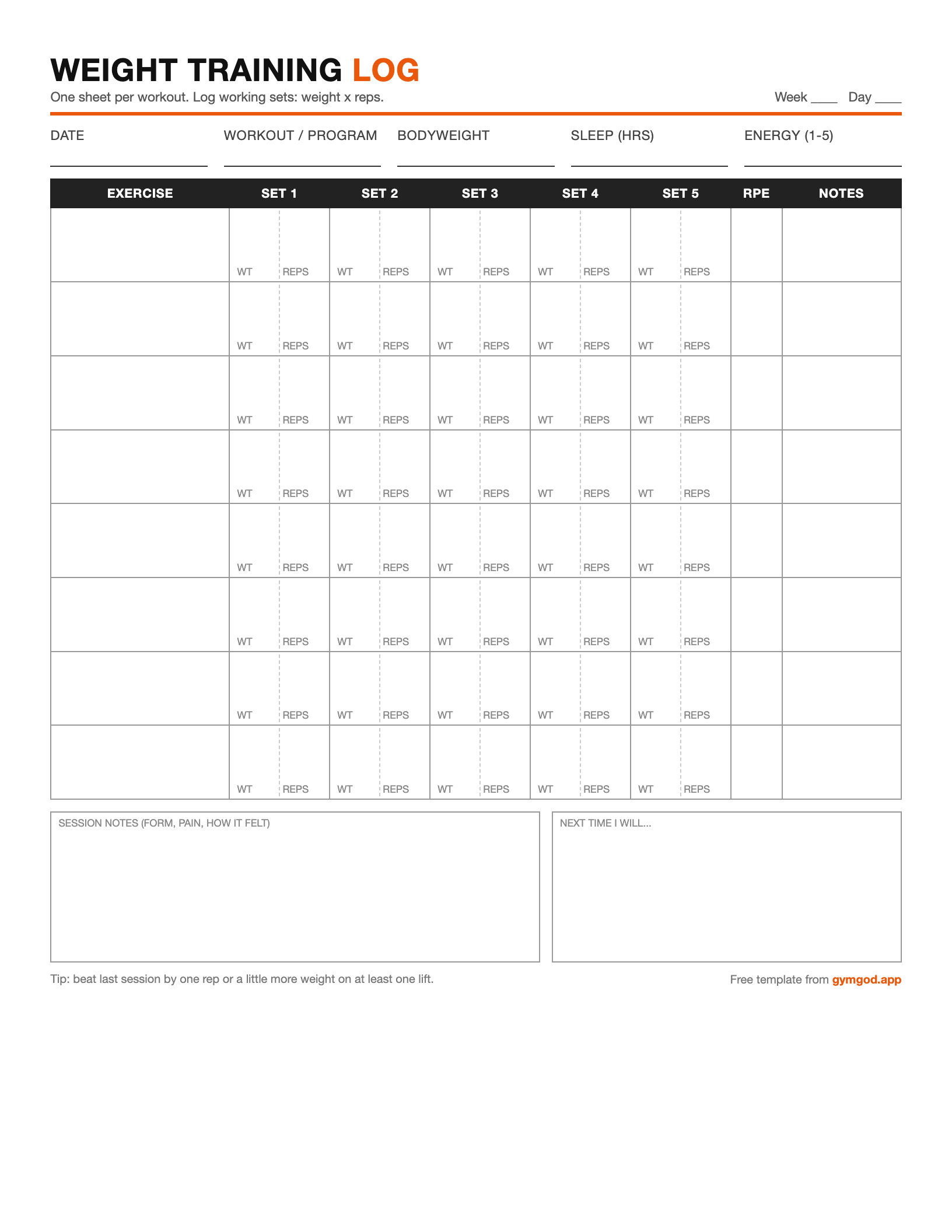
This post is the "what and why" list. If you want the "how", our beginner's guide to using a weight training journal walks through setting one up and reviewing it. If you just want something to write in, grab the free weight training log templates.
Why Bother Keeping a Workout Journal?
Getting stronger means doing a little more than last time: one more rep, a few more pounds, one more set. You cannot beat a number you do not remember. Most people who train without a log drift toward the same weights every week because "about what I did last time" quietly becomes "exactly what I did last time".
There is decent evidence that writing things down helps. A meta-analysis of 138 randomized studies found that interventions that got people to monitor their progress toward a goal improved how often they reached it, and the effect was larger when the progress was physically recorded (Harkin et al., Psychological Bulletin, 2016). An earlier review of 122 healthy eating and physical activity programs found that self-monitoring explained more of the difference between programs than any other technique, especially when it was paired with goal setting and feedback (Michie et al., Health Psychology, 2009). Neither study was about barbells specifically, but the lesson carries over: tracking works best when you compare the numbers against a goal.
The 10 Things to Track
1. Date and Session Name
What to write: the date, plus a name for the workout, like "Upper A", "Push" or "Week 3, Day 2".
Why it matters: the session name is what lets you find "last time". On a program with two or three different days, last Monday's squat session is the one to beat, not yesterday's upper body day. Dates also show you gaps. When you see you trained four times in three weeks, the stalled bench press stops being a mystery.
Example: Tue 21 Oct, Lower A (week 4)
Skip it? Never. It takes five seconds.
2. Exercises, in the Order You Did Them
What to write: each exercise by the same name every time, listed in the order you did it. Write down the variation too: close grip, paused, incline, machine or cable.
Why it matters: order changes performance. Romanian deadlifts done after heavy squats will be weaker than Romanian deadlifts done first, so comparing them across sessions with a different order is comparing apples to oranges. Consistent names matter for the same reason: if one week says "RDL" and the next says "stiff leg", you will not spot that the lift has stalled.
Example: 1. Squat 2. Romanian deadlift 3. Leg press
Skip it? No. This is one of the three essentials.
3. Weight Lifted
What to write: the load on the bar or the pin, in one unit you stick with. For barbells, write the total including the bar. For dumbbells, write the weight of one dumbbell. For machines, write the number on the stack, since stacks vary between gyms and brands.
Why it matters: weight is the clearest measure of progress you have. It is also the number you are most likely to misremember. "I think it was 185" is how people spend a month repeating a weight they already beat.
Example: Squat: 225 lb (102 kg). Dumbbell row: 60 lb (27 kg) each hand.
Skip it? No. If you change gyms, add a quick note that the new machines are not comparable.
4. Sets and Reps, Set by Set
What to write: the reps you actually did on each set, not the plan. "3 x 8" is the plan. "8, 8, 6" is what happened.
Why it matters: the gap between the plan and reality is the most useful information in any training log. If you got 8, 8, 6 at 135 lb, next time your goal is 8, 8, 7, not more weight. If you write "3 x 8" anyway, you will add weight too early and stall. Set-by-set reps also show fatigue: a big drop from set one to set three often means your rest was too short or the weight was a bit too heavy.
Example: Bench press 135 lb (61 kg): 8, 8, 6
Skip it? No. Exercise, weight, and sets and reps are the whole log for a beginner. You can skip writing down warm-up sets, though.
5. Effort: RPE or Reps in Reserve
What to write: how hard the set was, as a number. The simplest version is reps in reserve (RIR): how many more clean reps you could have done. RPE is the same idea on a 1 to 10 scale, where RPE 8 means two reps left. Our guide to the RPE scale explains both.
Why it matters: weight and reps tell you what you did, but not what it cost. 225 lb for 5 with two reps to spare and 225 lb for 5 with nothing left look identical on paper. The first means you are ready to add weight; the second means you should hold. Effort ratings are also an early warning: if the same weights keep feeling harder week after week, you may need a lighter week before you need a new program. The RPE calculator can turn a set and its RPE into a target weight for next time.
Example: Squat 225 lb (102 kg): 5 @ RPE 7, 5 @ RPE 8, 5 @ RPE 9
Skip it? Beginners can, or can rate only the last set of each exercise. Early on you are still learning what "two reps left" feels like, and almost every session is a new best anyway.
6. Rest Times
What to write: roughly how long you rested between sets, especially on your main lifts. A range is fine: "2 to 3 min".
Why it matters: rest is a hidden variable. Hitting 8, 8, 8 after five minutes of scrolling between sets is not the same as hitting 8, 8, 8 on 90 seconds. If your reps jump up or crash, rest is often the reason. Writing it down also keeps sessions from stretching to two hours; see our take on whether your rest times are too long.
Example: Squat: 3 min rest. Leg press: 90 sec.
Skip it? You can, if you rest about the same amount every session. Track it when reps are swinging around and you cannot tell why.
7. Personal Records
What to write: a mark next to any set that beats your previous best. Not just a heavier single: a rep PR (more reps at a weight) and a volume PR (more total work on an exercise) count too.
Why it matters: PRs are proof that the plan is working, and a list of them is the fastest way to see progress over months. They also tell you when progress has stopped. If your last squat PR was eight weeks ago, that is a fact worth acting on, not a feeling.
Example: Overhead press 95 lb (43 kg) x 8 ★ rep PR (was 6)
Skip it? You can always find PRs later by flipping back through the pages, but marking them takes a second and keeps you motivated.
8. Notes on Form, Pain and Equipment Settings
What to write: one short line, only when something is worth remembering. Seat and pin positions on machines. A cue that worked. A twinge, where it was, and on which rep. A grip or stance change.
Why it matters: equipment settings save you time and make machine lifts comparable from week to week. Form notes stop you from relearning the same lesson. Pain notes are the most valuable of all: "left knee, bottom of squat, third week in a row" is a pattern you will only see if it is written down.
Example: Lat pulldown: thigh pad on 4. Squat: "chest up" cue fixed the forward lean. Slight right shoulder pinch on last bench set.
Skip it? Skip it on days when nothing happened. A blank notes line is fine. A paragraph every session is not.
9. Bodyweight, Sleep and Energy
What to write: a few quick numbers at the top of the page: bodyweight if you are trying to gain or lose, hours of sleep, and energy on a 1 to 5 scale.
Why it matters: these explain the bad days. If your bench dropped and the top of the page says "5 hours sleep, energy 2", you know it was a rough day, not a broken program. Over weeks, bodyweight tells you whether your eating matches your goal: lifts climbing while bodyweight holds steady is great on a cut, but on a bulk it means you are not eating enough to gain.
Example: BW 165 lb (75 kg). Sleep 6.5 h. Energy 3/5.
Skip it? This is the most optional item on the list. Track it if you are changing your bodyweight on purpose or if your performance keeps swinging for no clear reason. Otherwise leave it out.
10. A Weekly Progress Check-In
What to write: once a week, two or three lines at the end of your last session. Did each main lift go up, stay flat, or go down? How many hard sets did you do per muscle group? Anything to change next week?
Why it matters: this is the step that turns a record into a plan. The daily entries tell you what to beat next session; the weekly check tells you whether the plan as a whole is working. It is how you catch a plateau in week two instead of month three, and how you know when it is time for more weight, more reps, or more sets, which is the heart of progressive overload. If several lifts are flat and effort ratings are creeping up, that is usually a sign you are due a deload week.
Example: Week 4: squat up 5 lb, bench flat (2nd week), row up 1 rep. Legs 12 sets, chest 9, back 12. Next week: bench back to 3 sets of 8 at 130 lb (59 kg), build up again.
Skip it? You can skip writing it, but do not skip doing it. Even a 60-second look back at the week counts.
What a Good Training Log Entry Looks Like
Here is one session with most of the list filled in. It takes about the same time to write as it takes to read, because each line is written during rest periods, not after the workout.
Tue 21 Oct · Lower A (week 4)
BW 165 lb (75 kg) · Sleep 7 h · Energy 4/5
| Exercise | Weight | Reps per set | Effort | Rest | Notes |
|---|---|---|---|---|---|
| Squat | 225 lb (102 kg) | 5, 5, 5 | RPE 7, 8, 9 | 3 min | ★ PR: first 3 x 5 at 225. "Chest up" cue. |
| Romanian deadlift | 185 lb (84 kg) | 8, 8, 7 | RPE 8, 8, 9 | 2 min | Grip going on set 3. Try straps? |
| Leg press | 360 lb (163 kg) | 12, 11, 10 | RIR 2, 1, 1 | 90 sec | Seat on 6. |
Notice the "next time" line at the bottom. It is the most useful line on the page, because it is the first thing you will read when you open the journal before your next lower day. The printable workout log (PDF) has columns for all of this, the weekly training log (PDF) fits a whole week on one sheet, the 12-week progress tracker (PDF) is built for the weekly check-in in item 10, and the spreadsheet log (CSV) opens in Google Sheets or Excel.
What to Track Based on Your Experience
| You are... | Track | Leave out for now |
|---|---|---|
| Brand new (first 3 months) | Date, exercises, weight, sets and reps (items 1 to 4) | Effort ratings, rest, recovery markers |
| Past the beginner gains | Items 1 to 4, plus effort on top sets, PRs, notes and a weekly check | Sleep and energy, unless something is off |
| Running a program with RPE targets | All of items 1 to 8 and 10 | Bodyweight, unless you are cutting or bulking |
| Cutting, bulking or coming back from injury | All 10 | Nothing, but keep each line short |
How to Track Workouts Without It Taking Over Your Session
A gym journal is supposed to serve the workout, not replace it. A few habits keep it quick:
- Write the plan before you arrive. Copy the exercises and last session's numbers onto today's page (or have them showing). During the workout you only fill in what changed.
- Log each set right after you rack it. Ten seconds during rest beats trying to remember six exercises in the car.
- Use shorthand. "225 x 5,5,5 @8" says everything. Write full sentences only in the notes line, and only when needed.
- Pick one unit and one name per lift. Changing either makes your history harder to read.
- End with the "next time" line. If you only add one thing beyond the essentials, make it this.
Paper or app is mostly a question of taste. We compared both in paper vs digital workout planners, so we will not repeat it here. The short version: pick the one you will actually open every session.
The Downsides of Tracking Too Much
A fitness journal can go wrong in the other direction too. Watch for these:
- Logging becomes the workout. If you are spending more time writing than lifting, or rest periods stretch because you are filling in columns, cut back to items 1 to 4.
- Data you never look at. Sleep scores, bar speed, heart rate, mood: if nothing you would do changes based on a number, stop writing it down.
- Chasing numbers through pain. A log makes beating last time feel urgent. A missed PR is fine. Grinding through a sharp pain to protect a streak is not.
- Turning bad days into a story. One low session in your training log is noise. Look for patterns over two or three weeks before you change anything.
The research above points the same way: monitoring helped when it was tied to a goal. A weight training journal pays off only when you read it before you train and try to beat what is on the page.
Let Your Log Do the Remembering
If you would rather not carry a notebook, GymGod covers most of this list for you. Your last weights, reps and goals appear the moment you start an exercise, so "last time" is always on screen. New personal records are detected automatically, with full PR history and total volume stats for your weekly check-in. A customizable rest timer starts between sets on its own, auto-progression calculates your next weight from what you actually lifted, and you can export your workouts anytime as a CSV if you like to dig through the numbers in a spreadsheet. Your first 3 workouts are free, with no account needed.
Frequently Asked Questions
What should I write in a workout journal?
At minimum: the date, each exercise, the weight, and the reps you did on every set. Once that is a habit, add effort (RPE or reps in reserve), rest times, PRs, short notes on form or pain, and a weekly check on whether your main lifts went up.
Should I log warm-up sets?
Usually not. Warm-ups rarely change, and logging them buries the working sets you actually need to compare. Write them down only if you are working around an injury or following a program that counts them.
Is a workout journal the same as a training log?
Yes. Workout journal, training log, gym journal and weight training journal all mean the same thing: a record of what you lifted so you can beat it next time. Some people use "fitness journal" for something broader that also covers food, cardio and habits.
How often should I review my workout journal?
Glance at the last entry for the same session before every workout, and do a short review once a week to check whether each main lift went up, stayed flat or went down. If a lift is flat for two or three weeks, change something.
Do beginners need to track RPE?
No. Beginners make progress almost every session and are still learning what a hard set feels like. Track exercise, weight, and sets and reps first, and add effort ratings for your top sets once progress slows.