
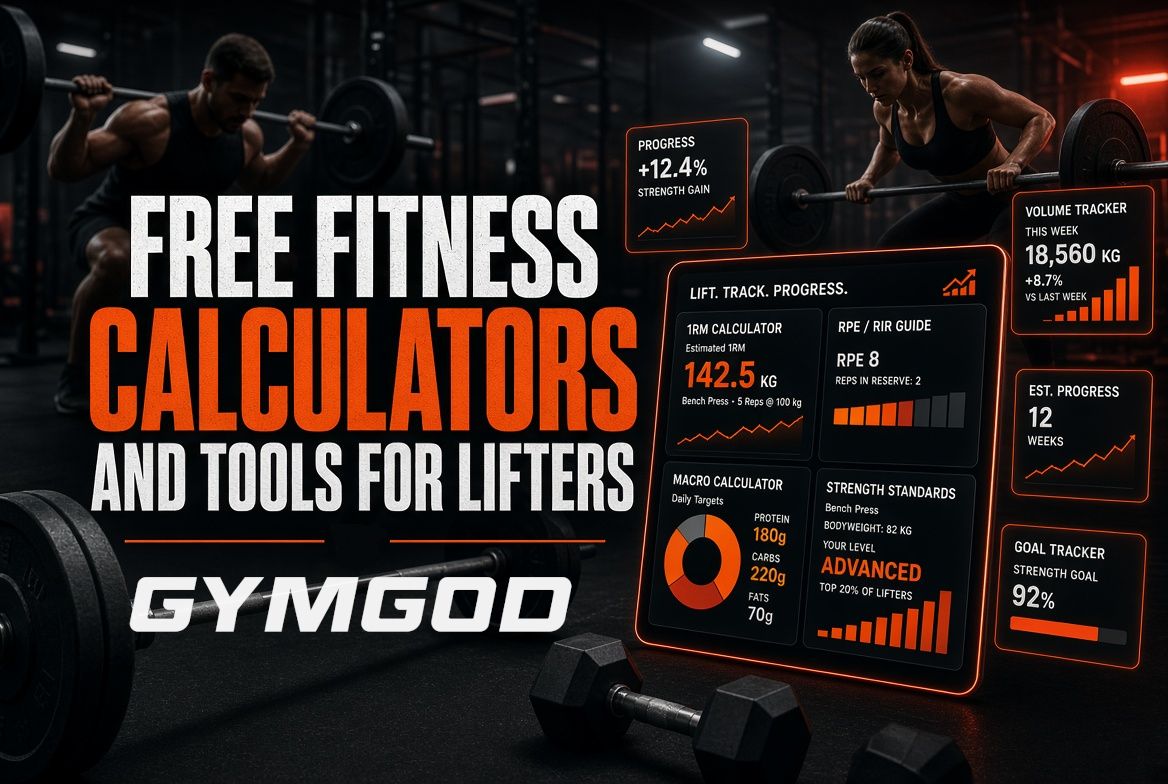
Most fitness calculators online are buried under pop-ups and autoplay ads, and many of them still use formulas that were never meant for people who lift. We built our own: free, ad-free, and with sources cited so you can see exactly where every number comes from.
This page lists every tool we offer: eight calculators, an exercise library, printable logs, a spreadsheet and a quiz. Bookmark it. We'll add to it as new tools go live.
Quick links:
• Calculators: calories and macros, ideal weight, BMI, strength percentiles, 1RM and RPE, body fat, muscular potential, plate loading
• Exercise library: video demos and form instructions
• Printable logs: workout log, weekly log, 12-week progress tracker
• Spreadsheet: training log for Google Sheets or Excel
• Quiz: what's blocking your gains?
8 Free Calculators for Lifters
Every calculator runs in your browser, works in pounds or kilos, and lets you copy a link to your results. Each page explains the formulas it uses and lists its sources, so you can check the math yourself.
Not sure where to start?
• Losing fat or building muscle? Start with the calorie calculator.
• Wondering what you should weigh? Check your BMI, try the ideal weight calculator, then the muscular potential calculator.
• Curious how strong you are? Estimate your max with the 1RM calculator, then see how you compare.
• Standing at the bar doing math? Use the plate calculator.
Nutrition and body composition
Calorie Calculator for Lifters
Daily calories and macros to cut, maintain or bulk, using Mifflin-St Jeor, Katch-McArdle or Harris-Benedict. Most calorie calculators only help you lose weight; this one covers lean bulks and bulks too.
Instead of a random zig-zag, it shifts calories toward the days you lift, keeping your weekly total the same. Add a goal weight and it estimates when you'll get there.
Open the calculatorIdeal Weight Calculator for Lifters
Seven answers to "what should I weigh?" side by side. It includes Dr. Steven Halls' People's Choice formula (from the well-known halls.md calculator, which is no longer online), the healthy BMI range, and the classic Devine, Robinson, Miller and Hamwi formulas.
What makes it different: add your body fat percentage and it shows your FFMI (fat-free mass index) and what you'd weigh leaner with the muscle you already have. BMI can't do that, and it's why so many lifters get labeled "overweight" at 12% body fat.
Open the calculatorBMI Calculator
Your body mass index, WHO category and healthy weight range for your height, plus BMI Prime and Oxford mathematician Nick Trefethen's "new BMI", which is fairer to tall and short people. There's an option for the lower cut-offs recommended for Asian populations.
For lifters: add your body fat percentage and it tells you whether a high BMI is muscle or fat.
Open the calculatorBody Fat Calculator
Estimate your body fat with a tape measure using the US Navy method: neck and waist for men, plus hips for women. You'll see your category on a color scale, your fat and lean mass, and your FFMI.
One tap sends your result into the ideal weight and calorie calculators, so you don't have to type it twice.
Open the calculatorMaximum Muscular Potential Calculator
How much muscle can you build without drugs? Three research-based estimates: Casey Butt's formula, which uses your wrist and ankle size to account for your frame; the FFMI natural ceiling from a 1995 study of athletes; and Martin Berkhan's height rule.
Enter your current weight and body fat to see how much of your estimated maximum you've already built.
Open the calculatorStrength
How Strong Am I?
Compare your squat, bench and deadlift with more than 340,000 raw powerlifters in your weight class. The comparison uses real meet results from the public OpenPowerlifting database, not someone's opinion of what "intermediate" means.
Enter all three lifts to get your Dots score, which adjusts your total for bodyweight so lifters of any size can be compared.
Open the calculatorOne-Rep Max & RPE Calculator
Estimate your max from any set without testing it. Use the Epley and Brzycki formulas, or add how hard the set felt (RPE) for a more accurate estimate.
You also get a percentage table and a full RPE chart, rounded to the plates you actually have, so your program's numbers are ready to load.
Open the calculatorBarbell Plate Calculator
Type a weight and see exactly which plates go on each side, drawn on a barbell. Works in pounds or kilos, with standard, women's and light bars.
Untick any plates your gym doesn't have, and it shows the closest weight you can load.
Open the calculatorUse them together
The calculators are built to feed into each other. A good path for a body-composition goal:
- Measure your body fat and see how it changes what your BMI means.
- Use it in the ideal weight calculator to pick a realistic goal weight.
- Check that goal against your muscular potential.
- Enter the goal in the calorie calculator to get your daily target and a timeline.
For strength, the path is shorter: estimate your max with the 1RM calculator, see how you stack up, then use the RPE chart and the plate calculator to plan your next session.
All eight are also on our calculators page. If you run a blog, gym site or coaching page, each one has a free embed code you can paste into your own site.
Exercise Library
Not sure how to do an exercise? Every movement in GymGod has a page with a video demo, step-by-step instructions and, for most, photos of the start and finish positions. Search all 173 by name, from the Arnold press to weighted pull-ups.
Printable Weight Training Logs
Free PDFs sized for US Letter (they print fine on A4 with "fit to page"). No email sign-up. Our weight training log guide explains how to fill them in and what to track.
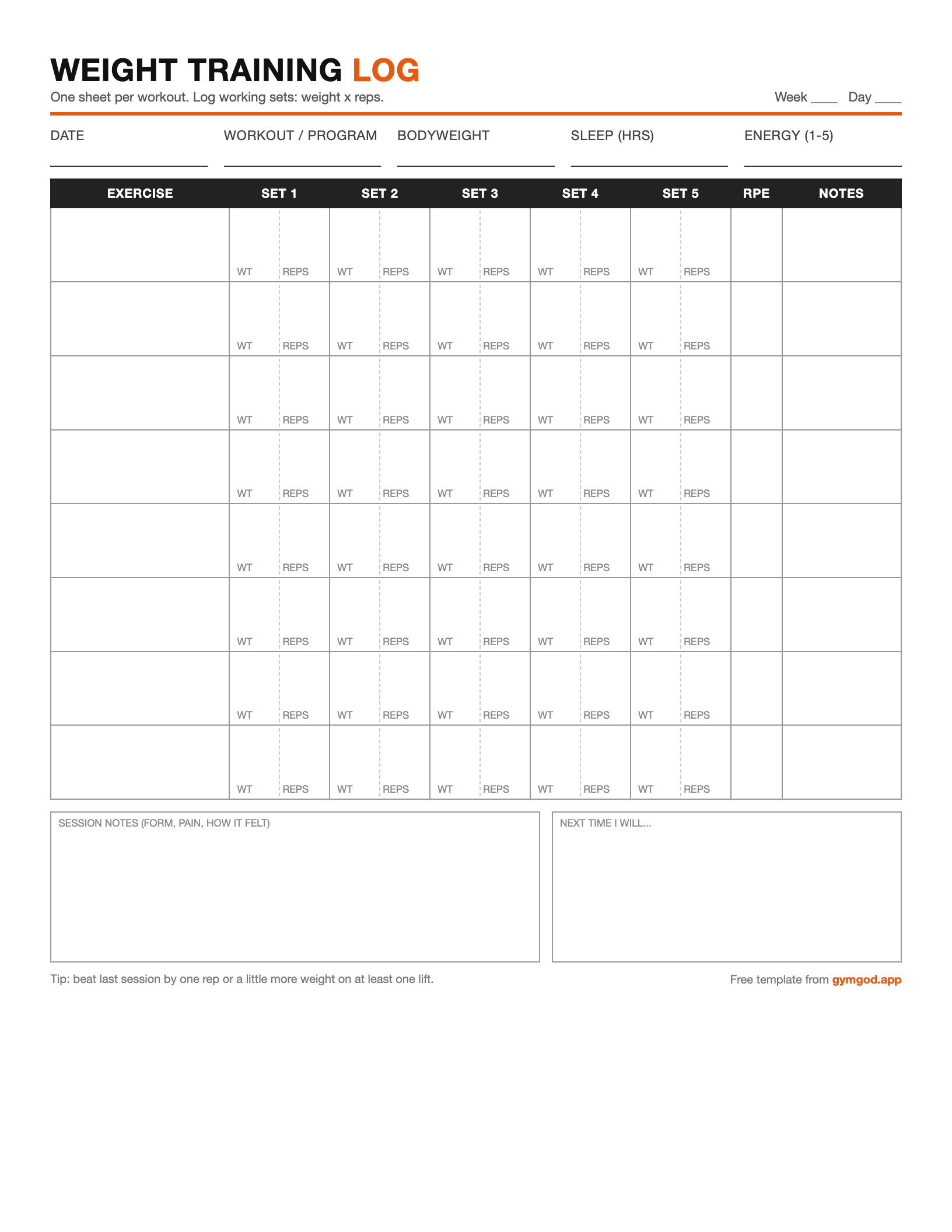
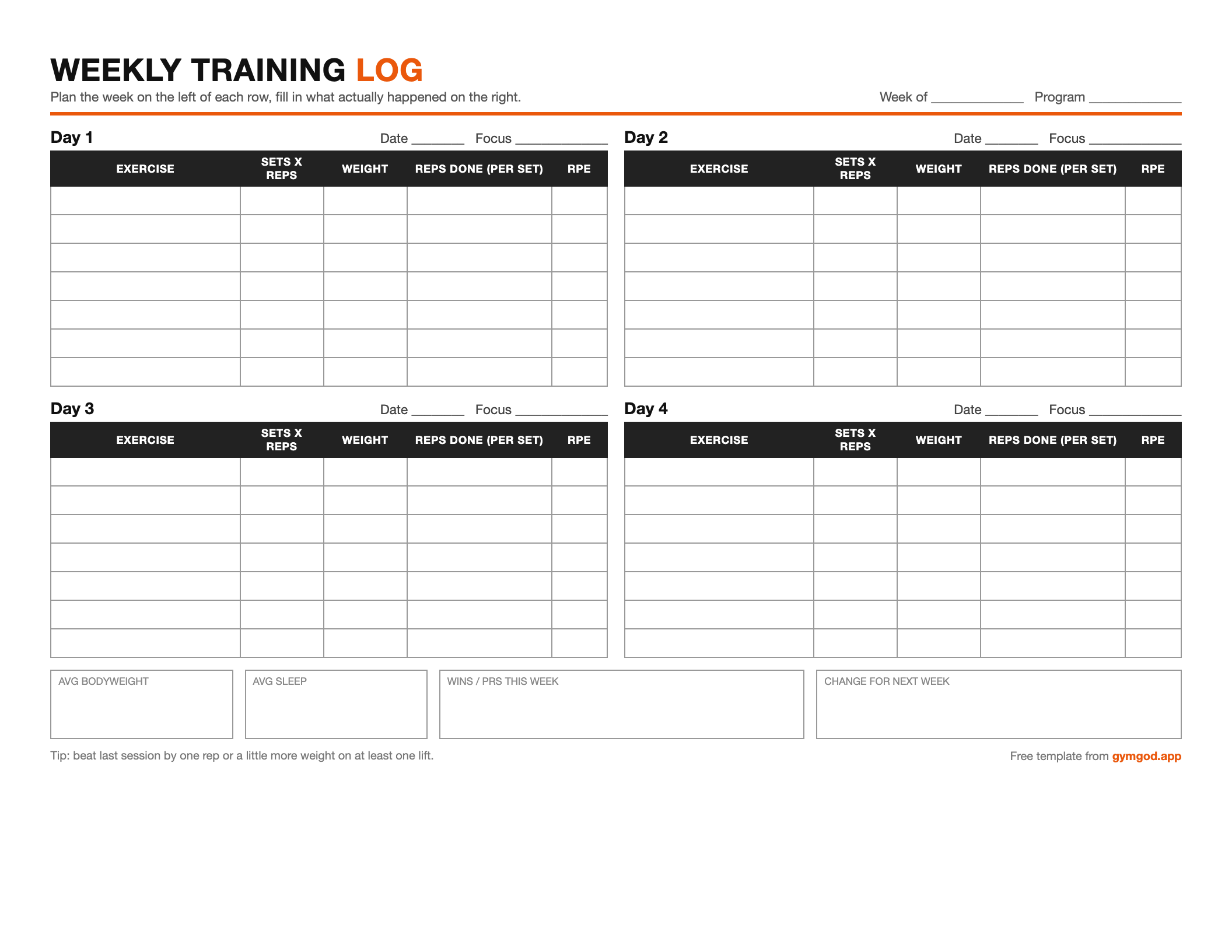
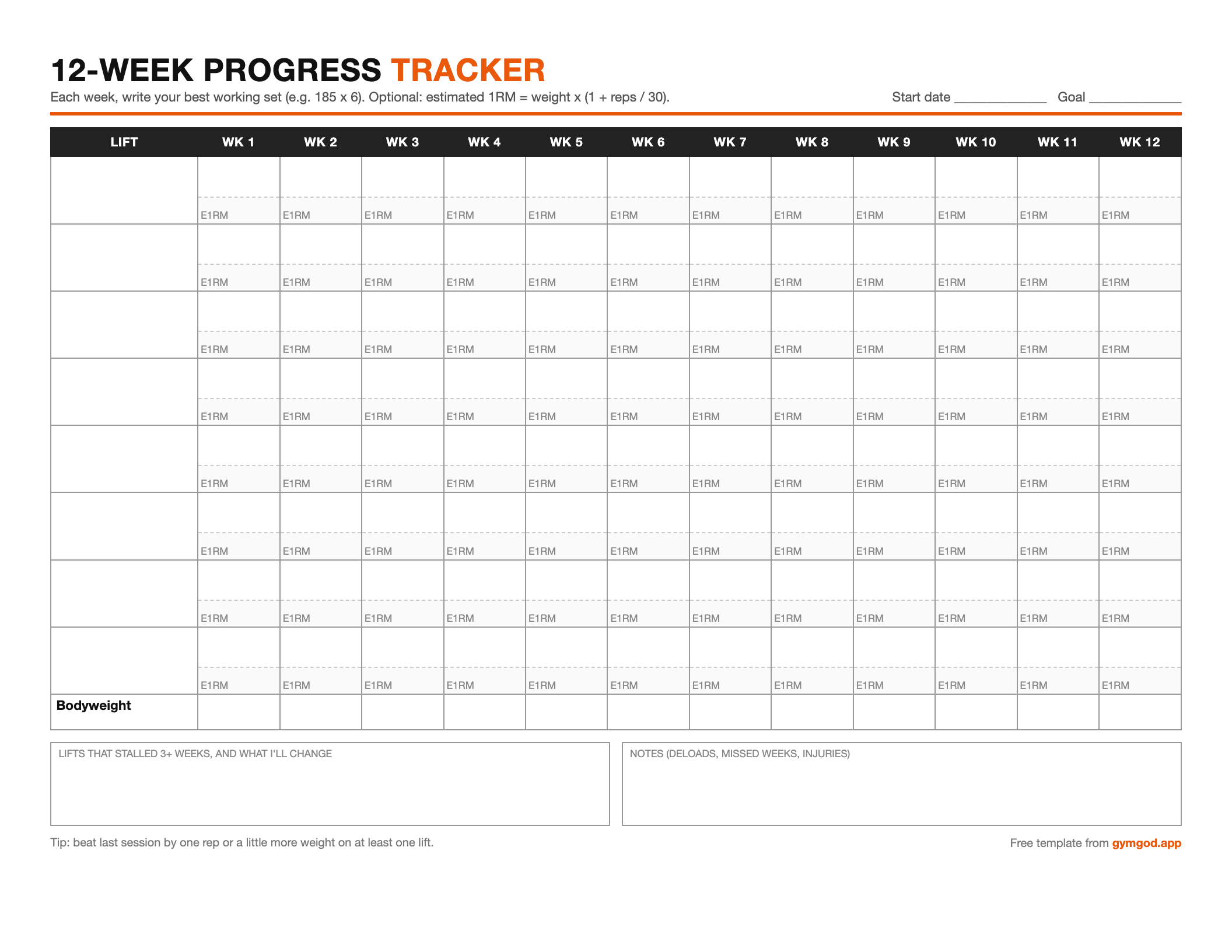
12-Week Progress Tracker
Best sets for up to eight lifts, plus bodyweight, across a 12-week block.
Download PDFTraining Log Spreadsheet
Prefer typing to writing? The same log as a spreadsheet (CSV). Open it in Google Sheets, Excel or Numbers, then sort and chart your lifts however you like.
Quiz: What's Blocking Your Gains?
Training hard but stuck? A short quiz that points to the most likely reason, whether it's consistency, recovery, eating or structure, and what to change first. Read more about the four lifter types.
Why We Make These Free
We build GymGod, a workout tracker for iPhone and Apple Watch. Calculators and printable logs are where most lifters start, and a good start makes it more likely you'll stick with training. If you outgrow paper, the app does the same job with less effort: it puts your last weights and reps on screen the moment you need them, and an on-device AI coach builds routines and gives tips from your training history. If paper works for you, keep using it. Tracking anything beats tracking nothing.