
Leg Training Guide
Squat, hinge, lunge, then beat last week.
A barbell leg day, a dumbbell-only leg day, and a progression plan that works for months.
What Is a Good Leg Day Workout?
A good leg day workout has four pieces: a squat for the quads, a hip hinge like the Romanian deadlift for the hamstrings and glutes, a single-leg exercise such as a split squat or lunge, and a calf raise. Do 3 to 4 sets of each, mostly in the 6 to 15 rep range, stop 1 to 3 reps short of failure, and add weight or reps every week or two. Train legs once or twice a week and that is enough to get stronger and build muscle.
Below you will find two complete routines: a barbell leg day for a gym with a squat rack, and a dumbbell leg workout for home or a crowded gym. Each comes with form cues, a beginner and an intermediate version, and a progression plan, plus an honest look at what each approach does well and where it falls short.
Why Leg Day Needs Both a Squat and a Hinge
Plenty of lifters treat squats as the whole leg day. Squats are great, but they do not train everything. In a 10-week study, people who did only full squats grew their quads, adductors and glutes, but their hamstring volume did not change at all (Kubo, Ikebukuro and Yata, European Journal of Applied Physiology, 2019). The same study found that full-depth squats grew the glutes and adductors more than half squats did.
Two practical takeaways: squat as deep as you can with good form, and give your hamstrings their own work with a hinge (Romanian deadlift) and, if you have one, a leg curl. Both routines below are built that way.
Barbell Leg Day Workout
You need a squat rack, a barbell, plates and a bench. A leg curl machine and leg press are nice to have but optional.
| Exercise | Sets | Reps | Rest |
|---|---|---|---|
| Barbell Back Squat | 4 | 5-8 | 2-3 min |
| Barbell Romanian Deadlift | 3 | 6-10 | 2-3 min |
| Bulgarian Split Squat | 3 | 8-12 per leg | 90 sec-2 min |
| Leg Curl | 3 | 10-15 | 60-90 sec |
| Calf Raises | 4 | 10-15 | 60 sec |
That is 17 hard sets and takes about 60 to 70 minutes including warm-ups. Use the one-rep max calculator to pick a starting squat weight from a recent set, and the plate calculator to load the bar without doing math between sets.
Beginner vs. Intermediate Version
- Beginner (first 3 to 6 months): squat 3x8, Romanian deadlift 3x10, leg press 3x10-12 instead of split squats, calf raises 3x12. Skip the leg curl if you are short on time. Leave 2 to 3 reps in the tank on every set while you learn the movements.
- Intermediate: run the full table above, and train legs twice a week. On the second day, swap the back squat for the front squat or leg press, and swap the Romanian deadlift for a hip thrust or lying leg curl so your lower back gets a break.
Barbell Back Squat: Form Cues
- Bar on your upper back, not your neck. Feet about shoulder width, toes turned out 15 to 30 degrees.
- Big breath into your belly, brace like you are about to be poked in the stomach, then sit down between your heels.
- Knees track over your toes. Go as deep as you can while your lower back stays neutral, ideally thighs at or below parallel.
- Drive up through your whole foot and keep your chest from collapsing forward.
Set the safety pins just below your bottom position. Then a failed rep is an annoyance, not an emergency.
Romanian Deadlift: Form Cues
- Start standing with the bar at your hips. Soft knees, and keep that small bend the whole set.
- Push your hips straight back like you are closing a car door with your butt. The bar slides down your thighs.
- Stop when you feel a strong hamstring stretch or your back starts to round, usually somewhere around mid-shin.
- Squeeze your glutes to stand back up. Do not lean back at the top.
How do you program an RDL workout? Treat it as your main hamstring lift: 3 sets of 6 to 10, after squats when your legs are warm but not wrecked. Most people can use more weight than they expect, but the stretch is what counts, so do not shorten the range to move more plates. The RDL causes a lot of soreness at first. Start light for the first two weeks and add weight from there.
Bulgarian Split Squat: Form Cues
- Rear foot on a bench, laces down. Front foot far enough forward that your front knee stays roughly over your foot at the bottom.
- Drop straight down until your back knee nearly touches the floor.
- A more upright torso puts more work on the quads. A slight forward lean puts more on the glutes.
- Do all reps on your weaker leg first, then match them on the stronger one.
Leg Curl and Calf Raise: Form Cues
- Leg curl: line up your knee with the machine's pivot point. Curl all the way, then take two to three seconds to lower. Do not let your hips lift off the pad.
- Calf raise: pause for a full second at the bottom stretch, then rise as high as you can and hold briefly. Bouncing out of the bottom lets your Achilles tendon do the work instead of your calves. Bent-knee seated calf raises are a good second-day swap.
Strengths: you can load a barbell almost without limit, so progress is easy to measure and keep going for years. It builds the most overall strength. Weaknesses: heavy squats and RDLs are tiring, both for your legs and your lower back, and recovery takes longer. You need a rack with safety pins to train hard alone. And if one leg is stronger, the barbell lets it quietly take over, which is why the routine includes a single-leg exercise.
Dumbbell Leg Workout (No Barbell, No Machines)
This routine needs a pair of dumbbells, a bench or sturdy box, and a step. It works in a garage gym, a hotel gym, or a commercial gym where every squat rack is taken.
| Exercise | Sets | Reps | Rest |
|---|---|---|---|
| Goblet Squat | 4 | 8-15 | 2 min |
| Dumbbell Romanian Deadlift | 3 | 10-15 | 2 min |
| Dumbbell Bulgarian Split Squat | 3 | 8-12 per leg | 90 sec-2 min |
| Dumbbell Step-Ups | 2 | 10-12 per leg | 90 sec |
| Single-Leg Romanian Deadlift | 2 | 10-12 per leg | 60-90 sec |
| Single-Leg Calf Raise (holding a dumbbell) | 3 | 12-20 per leg | 60 sec |
Notice the higher rep ranges. Dumbbells top out sooner than a barbell, so this routine leans on reps and single-leg work to make moderate weights hard. That still builds muscle: a meta-analysis of 21 studies found that lighter and heavier loads produced similar muscle growth when sets were taken to failure, while heavier loads built more one-rep max strength (Schoenfeld et al., Journal of Strength and Conditioning Research, 2017). The catch is that light sets only work if you push them close to failure.
Beginner vs. Intermediate Version
- Beginner: goblet squat 3x10, dumbbell RDL 3x12, reverse lunges 2x10 per leg instead of split squats (easier to balance), and two-leg calf raises 3x15. Skip the single-leg RDL until your balance is solid.
- Intermediate: run the full table. When your heaviest dumbbell makes goblet squats too easy, move the goblet squat to the end as a high-rep finisher and start the session with Bulgarian split squats instead.
Goblet Squat: Form Cues
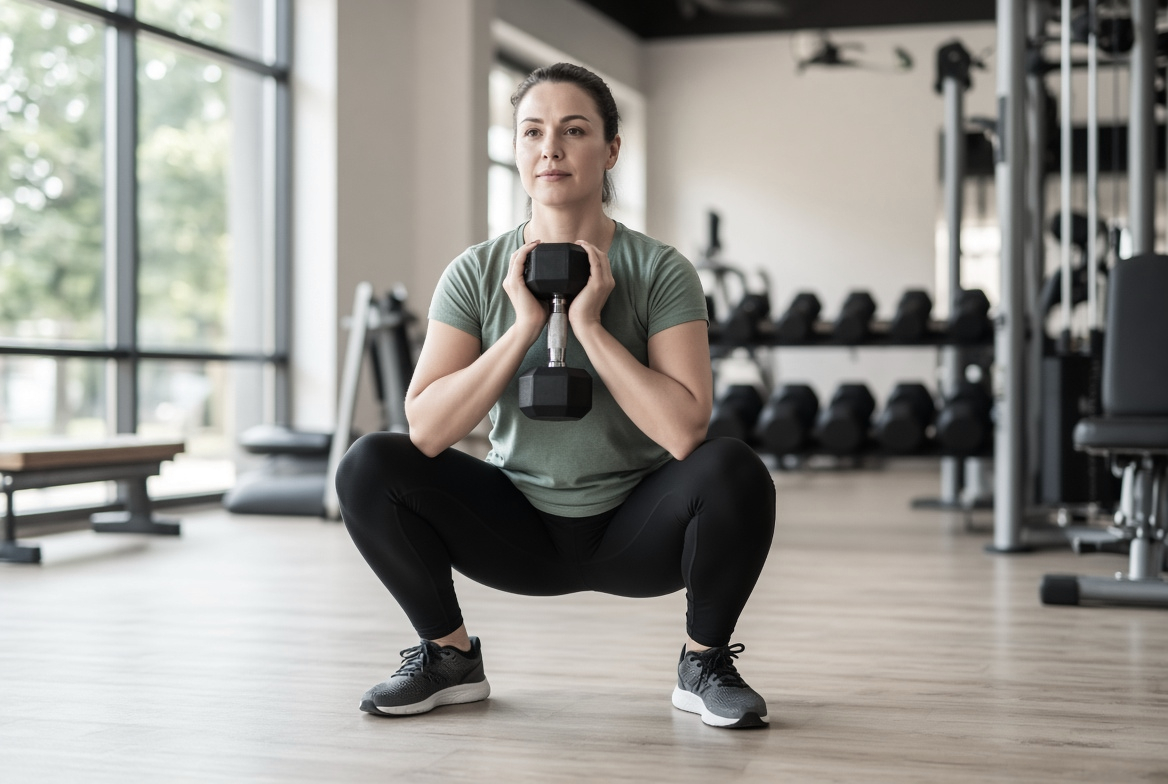
- Hold one dumbbell vertically against your chest, hands cupping the top end.
- Sit down between your heels, letting your elbows travel inside your knees at the bottom.
- Keep the dumbbell glued to your chest. If it drifts forward, your torso is folding over.
- Pause for a second at the bottom when the weight starts feeling light. It makes every rep harder without new equipment.
Dumbbell RDL and Single-Leg RDL: Form Cues
- Same hinge as the barbell version: soft knees, hips back, dumbbells sliding down the front of your thighs.
- Dumbbells let you go slightly deeper than a barbell because no plates hit the floor. Only go as low as your back stays flat.
- Single-leg RDL: hold the dumbbell in the hand opposite your working leg. Let your back leg rise as your torso lowers, and keep your hips square to the floor instead of opening up to the side. Lightly touching a wall with your free hand is fine.
Dumbbell Step-Ups: Form Cues
- Use a box or bench that puts your thigh roughly parallel to the floor when your foot is on it.
- Drive up through the front foot only. If you push off the back toes, the trailing leg is doing the work.
- Lower yourself slowly instead of dropping down.
Strengths: minimal equipment, no spotter needed, easier on the lower back, and the single-leg work fixes left-right imbalances. Weaknesses: your heaviest pair of dumbbells caps your progress, and your grip may give out on RDLs before your hamstrings do. Single-leg exercises also take longer because you train each side separately, and balance can limit how hard you push at first.
Barbell or Dumbbell: Which Leg Day Should You Do?
Use the equipment you have. Both routines train the same movement patterns, and both will build muscle if you progress them. If you have access to both, they fit together well:
- Twice-a-week legs: do the barbell day first in the week (heavy, lower reps) and the dumbbell day later (lighter, higher reps, more single-leg work). This fits neatly into an upper/lower split.
- Once-a-week legs: run the barbell day, and rotate in one dumbbell exercise like step-ups when you want variety.
- Training at home: run the dumbbell day twice a week, or fold its main lifts into a full-body routine.
Leave at least 48 hours between hard leg sessions, and do not stack a heavy RDL day right before a heavy deadlift day. Your lower back recovers more slowly than your legs.
Warm-Up Before Leg Day
Five minutes on a bike or a brisk walk, then 10 bodyweight squats and 10 bodyweight good mornings. After that, warm up the first exercise itself: an empty bar (or a light dumbbell) for 8 to 10 reps, then two or three sets that climb toward your working weight with fewer reps each time. The later exercises need only one light set because you are already warm.
How to Progress Your Leg Day Workout
The routine is the easy part. Getting better at it every week is what makes your legs grow. Use double progression, explained in depth in our progressive overload guide:
- Pick a weight you can lift for the bottom of the rep range (for example, 8 reps on an 8-12 range) with 1 to 3 reps left in the tank.
- Each session, try to add a rep or two to some sets at the same weight.
- When you hit the top of the range on every set, add weight. On barbell squats and RDLs that is usually 5 to 10 lb (2.5 to 5 kg). On leg curls and calf raises, the smallest jump the machine allows.
- Drop back to the bottom of the rep range with the new weight and repeat.
When you run out of dumbbells: add reps until you reach the top of the range, then make the exercise harder without adding weight. Slow the lowering to three or four seconds, add a one-second pause at the bottom, use 1.5 reps (go down, come halfway up, go back down, then stand up), or switch to a single-leg version. Each of these makes the same dumbbell feel heavier.
When progress stalls: first check sleep, food and whether your sets are actually close to failure. If two or three sessions pass with no progress, drop the weight about 10 percent and build back up. Not sure how close to failure you are? The RPE calculator helps you match effort to load. Curious how your squat compares? Check the strength standards.
Soreness, Fatigue and Other Honest Downsides
- Soreness. The first two or three leg days will probably make stairs unpleasant, especially from RDLs and split squats. It fades quickly as you train consistently. Start with fewer sets and lighter weights than you think you need.
- Fatigue. Leg day is the most tiring session of the week for most people. Big lifts leave you breathing hard, so the rest times above are not a suggestion to scroll your phone. Take the full rest on squats and RDLs. On smaller exercises you can shorten it (see whether your rest times are too long).
- Lower back load. Squats and RDLs both load your lower back. If it is the limiting factor, swap the back squat for the leg press or goblet squat for a while.
- Knees. Healthy knees can handle deep squats and knees traveling past the toes. If a movement hurts, reduce the depth or weight, or pick a different exercise, rather than grinding through pain.
Common Leg Day Mistakes
- Half reps on squats. Partial squats let you load more weight, but full-depth squats built more glute and adductor muscle in the Kubo study above.
- No hamstring work. Squats and leg presses barely train the hamstrings. Include an RDL or leg curl every leg day.
- Turning RDLs into regular deadlifts. If the weights touch the floor and you are bending your knees a lot, you have lost the stretch that makes the exercise work.
- Skipping calves until the end of the program. Calves respond like any other muscle. Give them full-range reps and real effort.
- Not writing anything down. If you do not know what you lifted last week, you cannot reliably beat it. Use the printable weekly training log or the 12-week progress tracker if you like paper.
If your legs have stopped growing and you are not sure why, the What's Blocking Your Gains quiz takes a couple of minutes. Want more glute focus? See the best glute exercises.
Tracking Your Leg Days
Double progression only works if you remember that you did 3 sets of 10 at 135 lb on RDLs last Tuesday, and that two of those sets were close to the top of the range. If you use GymGod, your last weights and reps appear the moment you start an exercise, auto-progression calculates your next target from what you actually lifted, and new PRs are detected automatically. A notebook works too. Whatever you use, write it down and try to beat it next time.
Leg Day Workout FAQ
How many exercises should a leg day have?
Four to six is plenty: a squat, a hip hinge like the Romanian deadlift, a single-leg exercise, a hamstring curl if you have the machine, and a calf raise. More exercises usually means lower-quality sets at the end.
How often should I train legs?
Once a week works, especially for beginners. Twice a week lets you spread the sets out so each session is shorter and higher quality. Leave at least 48 hours between hard leg sessions.
Can you build big legs with only dumbbells?
Yes, up to a point. Goblet squats, dumbbell RDLs, split squats and step-ups train every major leg muscle, and lighter loads build muscle when sets are pushed close to failure. Once your dumbbells feel light, use single-leg variations, slower lowering and pauses to keep progressing.
Are Romanian deadlifts enough for hamstrings?
They are the best single hamstring exercise for most people, but adding a leg curl trains the hamstrings at the knee as well as the hip. If you only have dumbbells, single-leg RDLs make a good second hamstring exercise.
Should I squat or deadlift first on leg day?
Squat first. It is the more technical lift and needs fresh legs. Romanian deadlifts go second, when you are warm but not exhausted.
Why am I so sore after leg day?
New exercises, deep stretches under load (RDLs and split squats especially) and long breaks between leg days all cause more soreness. Training legs consistently every week is the best way to reduce it.